



Rassie Erasmus · Siya Kolisi · Ireland head coach Andy Farrell · Ireland’s Caelan Doris · FILE PHOTOS
Research date: 15 November 2026 · Match: Saturday, 21 November 2026 · Aviva Stadium, Dublin
South Africa and Ireland have been playing Test rugby against each other since 1906. The Springboks lead the historical record, but the modern rivalry tells a much more complicated story: Ireland have won nine of the 15 meetings since November 2004, including the 2023 Rugby World Cup pool match.
Now they meet again in Dublin, with both teams carrying something significant into the final round of the Nations Championship.
For South Africa, the match is about more than responding to the 21–19 defeat against France. It is about securing the strongest possible position in the Southern Hemisphere standings, keeping a route to the Grand Final open, and understanding exactly what must happen in the other fixtures.
For Ireland, the stakes are just as serious. Their 43–15 victory over Fiji has kept them in contention for the Northern Hemisphere's top position. They are not simply hosting the world champions. They are competing for a place in the final.
This is 120 years of rivalry meeting a tournament whose mathematics could decide the Springboks' next step.
There are three different questions that must not be confused:
That distinction is central to the investigation. Rassie Erasmus said the France defeat had effectively killed the Springboks' Nations Championship dream. He was reacting immediately after the loss, before New Zealand's defeat to Wales had been added to the standings. The updated mathematics still leaves South Africa a route to the top seed. Reuters, 14 November.
The first meeting: 24 November 1906
South Africa and Ireland first met in a full international Test in Belfast in 1906. Ireland lost 12–15. One hundred and twenty years later, the rivalry stands at 31 Tests.
| Statistic | Record |
|---|---|
| Total Tests | 31 |
| South African victories | 20 |
| Irish victories | 10 |
| Draws | 1 |
Source: IRL Rugby head-to-head record, cross-referenced with World Rugby match records.
South Africa lead the overall record. But the historical advantage does not tell the full story.
Since Ireland defeated South Africa 17–12 in November 2004, the Irish have won nine of the next 15 meetings.
South Africa have won six.
That is a significant shift. The Springboks still lead the historical rivalry, but Ireland have been the more successful side across the modern 15-Test period.
The Springboks’ biggest winning margin in the fixture.
Ireland’s biggest win over South Africa, by 35 points in Dublin.
A three-point Irish win in Dublin.
Rugby World Cup Pool B, Stade de France.
First Test, Pretoria.
Second Test, Durban. Series 1–1.
First Springbok win away to Ireland in 13 years.
30 November 1912 — South Africa 38–0 Ireland
South Africa recorded a 38-point victory over Ireland, which remains the Springboks' biggest winning margin in the fixture.
11 November 2017 — Ireland 38–3 South Africa
Ireland's biggest victory over the Springboks.
Ireland won by 35 points in Dublin. The result remains the largest Irish victory in the history of the rivalry.
5 November 2022 — Ireland 19–16 South Africa
Another narrow Irish victory in Dublin. The Springboks were beaten by three points in a match that reinforced how difficult Ireland had become to overcome at home.
23 September 2023 — Ireland 13–8 South Africa
The Rugby World Cup Pool B encounter at the Stade de France.
Ireland won one of the most consequential matches of the modern rivalry. South Africa had opportunities, including a missed penalty opportunity, but Ireland held on.
The result mattered beyond the pool table. It showed that Ireland could beat the Springboks on a neutral field at a Rugby World Cup.
6 July 2024 — South Africa 27–20 Ireland
South Africa responded in Pretoria.
13 July 2024 — South Africa 24–25 Ireland
Ireland took the second Test in Durban by one point. The two-match series finished 1–1.
22 November 2025 — Ireland 13–24 South Africa
The Springboks won in Dublin, securing their first victory away to Ireland in 13 years.
The match was defined by South Africa's scrum and Ireland's discipline. The Springboks won six scrum penalties, one of which resulted in a penalty try. Ireland had four players yellow-carded, while James Ryan received a 20-minute red-card sanction. Official match report.
The 2025 result is important because it provides the most recent evidence of how South Africa can beat Ireland in Dublin: establish dominance at the set-piece, force the opposition to defend repeatedly, and turn scrum pressure into points.
The overall record hides an important difference between the teams' performances at home and away.
| Location | Tests | Ireland wins | SA wins | Draws |
|---|---|---|---|---|
| Ireland | 18 | 7 | 10 | 1 |
| South Africa | 12 | 2 | 10 | 0 |
| Neutral | 1 | 1 | 0 | 0 |
| Total | 31 | 10 | 20 | 1 |
South Africa have won 10 of 12 Tests played in South Africa against Ireland.
In Ireland, the contest is considerably closer: the Irish have won seven of 18, with one draw.
The neutral-ground meeting was the 2023 Rugby World Cup match in France, which Ireland won 13–8.
There is another detail worth watching. Since 2010, Ireland and South Africa have been level at three wins apiece in six Tests at the Aviva Stadium. The 21 November match can therefore change the balance at the venue. IRL Rugby venue record.
Ireland arrived in South Africa in June 2016 for a three-Test series.
The results were:
| Date | Test | Result |
|---|---|---|
| 11 June | South Africa v Ireland | Ireland won 26–20 |
| 18 June | South Africa v Ireland | South Africa won 32–26 |
| 25 June | South Africa v Ireland | South Africa won 19–13 |
Series result: South Africa won 2–1.
Ireland took the first Test at Newlands. South Africa recovered to win the next two.
The importance of the series was not simply the final result. Ireland had demonstrated that they could beat the Springboks in South Africa, rather than relying on home advantage in Dublin.
That changed the context of the rivalry.
Ireland won by 35 points.

It remains Ireland's biggest victory over South Africa.
This result became a defining reference point whenever the two sides met in Dublin. It was not a narrow escape or a late penalty. Ireland dominated the scoreboard and inflicted one of the most damaging defeats in Springbok history.
The result also established a psychological reference point: Ireland knew they could dismantle South Africa, and the Springboks knew what a poor performance in Dublin could look like.
November 2022: Ireland 19–16 South Africa
A narrow victory in Dublin.
September 2023: Ireland 13–8 South Africa
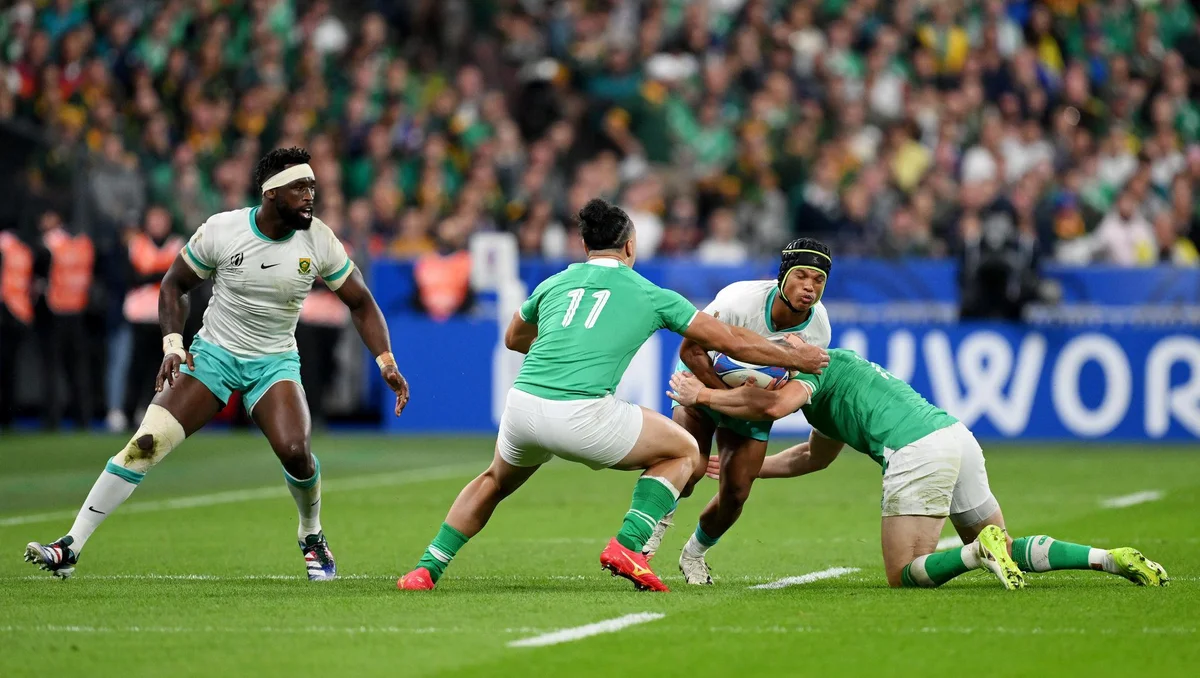
This was a different level of pressure.
It was a Rugby World Cup Pool B match, with both teams among the tournament favourites. Ireland won.
South Africa had opportunities, including a missed penalty opportunity and a late attacking sequence, but Ireland held on.
That result mattered because it showed Ireland could beat South Africa at a neutral venue, on the biggest international stage.
Both teams subsequently reached the quarter-finals. South Africa defeated France, while Ireland lost to New Zealand.
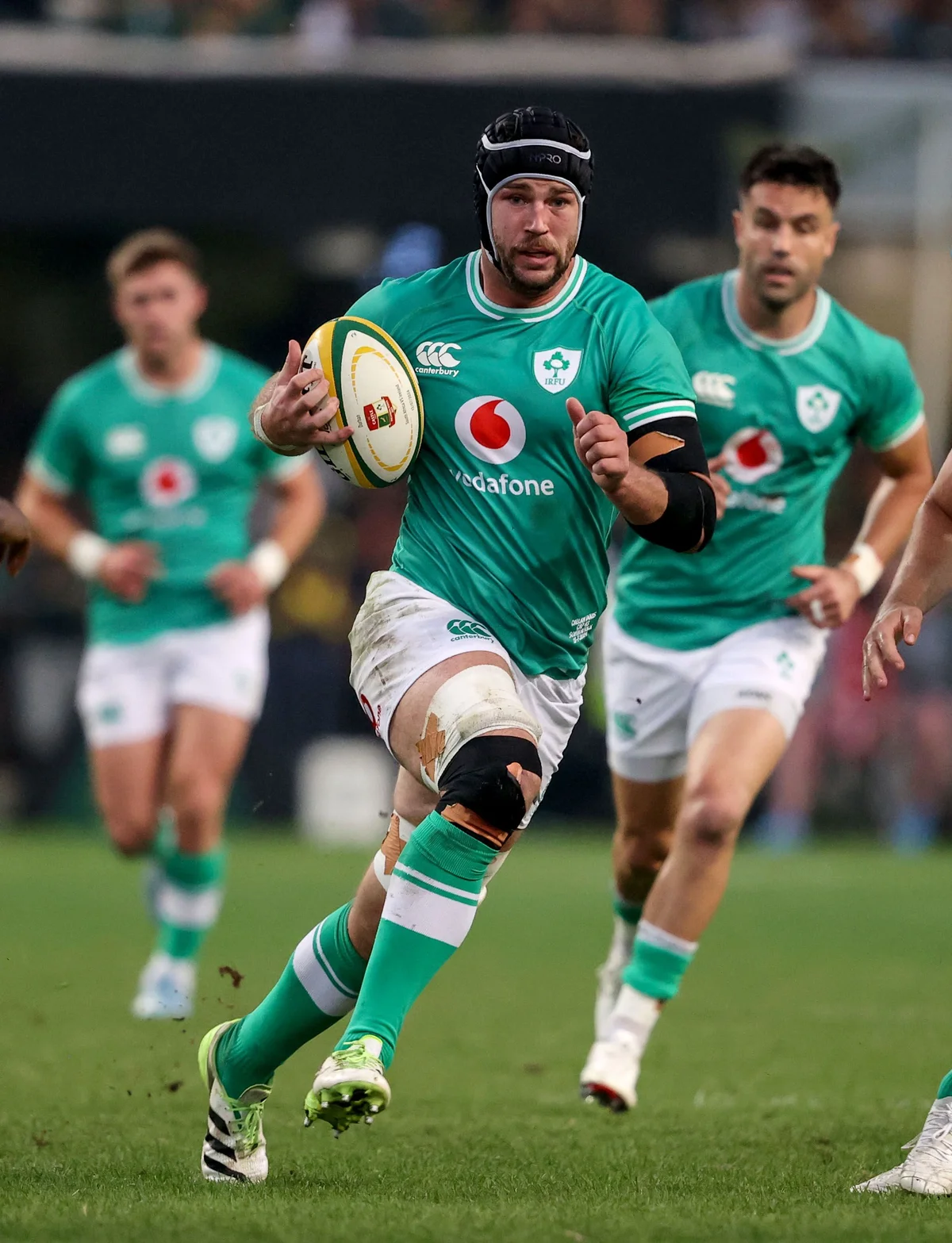
Two matches. Two different winners.
| Test | Result | Winner |
|---|---|---|
| Pretoria, 6 July | South Africa 27–20 Ireland | South Africa |
| Durban, 13 July | South Africa 24–25 Ireland | Ireland |
The series ended 1–1.
The aggregate score was:
South Africa scored six more points across the two Tests, but Ireland still took the second match by one point.
That is important context for November 2026. Ireland have repeatedly demonstrated that they can make the Springboks uncomfortable, even when South Africa are playing at home.
The Springboks won their first match away to Ireland in 13 years.
The defining feature was the scrum.
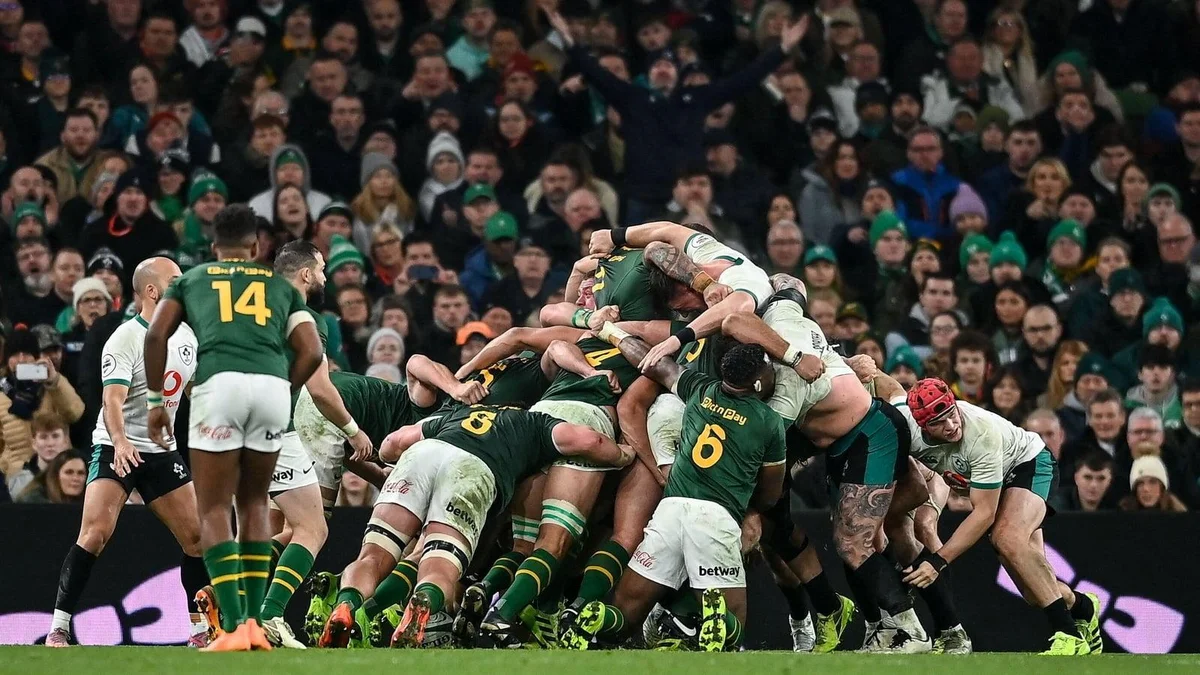
According to the official match report:
The Springboks won 24–13.
This is particularly important because it provides a recent example of how South Africa can beat Ireland: by imposing themselves physically, dominating the set-piece and forcing Ireland into repeated defensive penalties.
The question for 21 November is whether South Africa can reproduce that pressure against an Irish side that has had another year to prepare for the Springbok scrum.
There is another disciplinary storyline hanging over this Dublin encounter — and it involves Ireland tighthead Tadhg Furlong.
In October, Furlong was cited under World Rugby Law 9.27 after Munster No. 8 Gavin Coombes alleged that his groin had been grabbed during Leinster's 24–18 victory over Munster. The complaint was subsequently unanimously dismissed by an independent URC disciplinary committee, meaning Furlong received no suspension and remained available for Ireland.
But the case attracted particular attention in South Africa because of its striking similarities to the Jan-Hendrik Wessels incident, in which the Bulls prop received an eight-match suspension following an allegation by Connacht's Josh Murphy.
ScrumAtMe examined both cases in its 30 October investigation, “BALLS, BANS & BOARDROOMS: RASSIE'S WARNING, TWO GENITAL-GRABBING CASES AND A VERY UNCOMFORTABLE QUESTION FOR RUGBY.” As that investigation put it: “Two allegations involving contact with an opponent's genital area. The same disciplinary law. The same citing commissioner.”
The outcomes, however, were dramatically different: eight matches for Wessels, zero for Furlong.
The committee's decision did not establish that Furlong had committed the alleged offence, and the comparison is not proof of bias. But with Furlong now part of Ireland's November campaign, the episode adds another layer to the scrutiny surrounding the physical and disciplinary edge of this rivalry.
The full investigation is available on ScrumAtMe – The Daily Scrum.
The five most recent Tests between the teams, from November 2022 onwards:
| Date | Match | Result |
|---|---|---|
| 5 Nov 2022 | Ireland v South Africa | Ireland 19–16 |
| 23 Sep 2023 | Ireland v South Africa | Ireland 13–8 |
| 6 Jul 2024 | South Africa v Ireland | South Africa 27–20 |
| 13 Jul 2024 | South Africa v Ireland | Ireland 25–24 |
| 22 Nov 2025 | Ireland v South Africa | South Africa 24–13 |
Across those five matches:
| Measure | South Africa | Ireland |
|---|---|---|
| Victories | 2 | 3 |
| Points scored | 99 | 90 |
| Average points per match | 19.8 | 18.0 |
Ireland have won three of the five, but South Africa have scored nine more points overall.
This is an interesting rivalry: Ireland have won more individual encounters, while South Africa have scored more points across the sequence. IRL Rugby five-match record.
The central tactical question for 21 November: Can Ireland withstand the Springbok forward pressure for 80 minutes, and can South Africa avoid repeating the disciplinary mistakes that cost them against France?
This is where the story becomes particularly interesting.
The Springboks lost to France. New Zealand lost to Wales. Ireland beat Fiji. England demolished Japan.
Those results have changed the standings and the qualification picture.
The important point is that South Africa's defeat did not automatically remove them from the race to finish first in the Southern Hemisphere.
Snapshot: after the completed 14 November fixtures and before Scotland v Australia on 15 November.
Southern Hemisphere
| Position | Team | Played | Points | Difference |
|---|---|---|---|---|
| 1 | New Zealand | 5 | 22 | +66 |
| 2 | South Africa | 5 | 21 | +138 |
| 3 | Argentina | 5 | 11 | −27 |
| 4 | Australia | 4 | 8 | +6 |
| 5 | Japan | 5 | 5 | −96 |
| 6 | Fiji | 5 | 0 | −161 |
Northern Hemisphere
| Position | Team | Played | Points | Difference |
|---|---|---|---|---|
| 1 | France | 5 | 21 | +80 |
| 2 | England | 5 | 20 | +134 |
| 3 | Ireland | 5 | 20 | +57 |
| 4 | Wales | 5 | 15 | −28 |
| 5 | Scotland | 4 | 11 | −11 |
| 6 | Italy | 5 | 1 | −158 |
Source: Nations Championship standings, updated 14 November. Scotland and Australia had one Round 5 fixture still to play at the time of this snapshot.
The Southern Hemisphere situation is straightforward:
South Africa have the superior points difference by 72 points.
That could become decisive.
The Northern Hemisphere is much tighter. France lead on 21 points, while England and Ireland are both on 20.
There are three teams still competing for the top position.
Every match offers:
| Match outcome | Competition points |
|---|---|
| Win | 4 |
| Draw | 2 |
| Try bonus — four or more tries | +1 |
| Losing bonus — defeat by 7 or fewer | +1 |
A team can therefore earn:
The first tiebreakers are the number of victories and then points difference. Nations Championship standings and tiebreak criteria.
That means the scoreboard alone does not tell the whole story. The number of tries and the margin of defeat can change the competition table.
The Springboks entered the France match with 20 competition points.
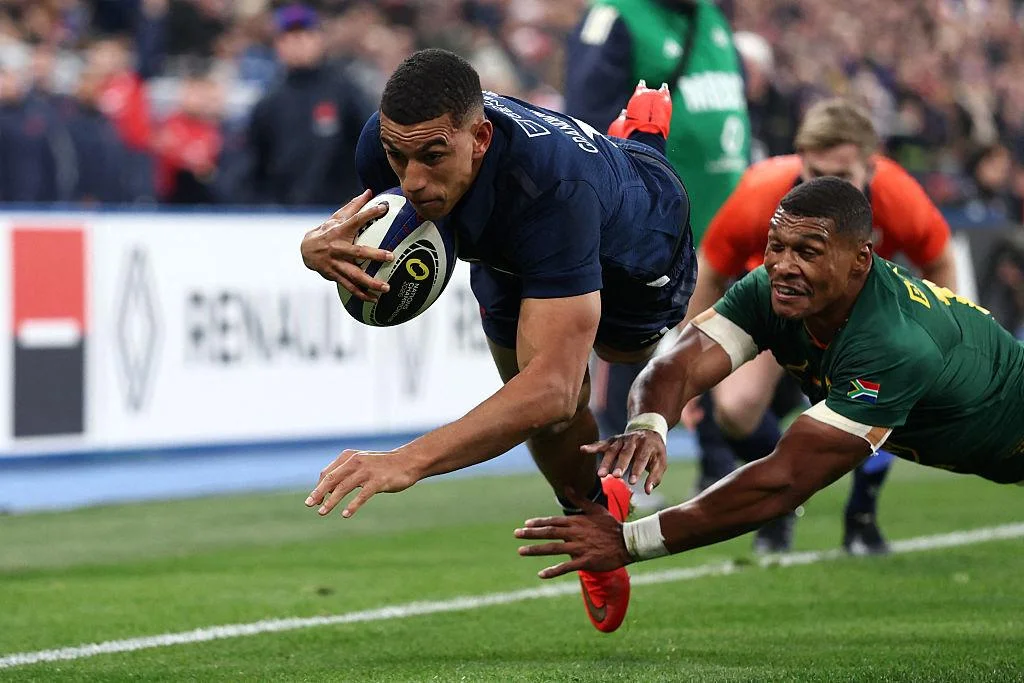
They had an opportunity to collect five more.
Instead:
Their total moved from 20 to 21 points.
The defeat was not just a loss of two points on the rugby scoreboard. It was a missed opportunity to collect a possible five competition points.
Rassie Erasmus was visibly frustrated afterwards.
He said:
“I think we basically killed our dreams for the Nations Championship tonight.”
He also pointed to the failure to take the opportunities that were available to the Springboks.
The disciplinary figures were significant:
Erasmus accepted that the cards were warranted and said the discipline had hurt the team. Reuters match report.
But there is an important timing distinction.
Rassie made that assessment immediately after the France defeat, before New Zealand's result against Wales had been added to the standings.
The subsequent result was:
New Zealand lost by seven points but scored four tries.
They therefore collected two bonus points:
That took New Zealand to 22 points, one ahead of South Africa.
The result changed the standings. It did not mathematically eliminate South Africa from finishing first in the Southern Hemisphere.
That is the distinction between Rassie's immediate frustration and the updated tournament mathematics.
This is the most important calculation in the entire article.
Remaining matches
New Zealand have one point more than South Africa. Both teams have one match remaining.
A South African victory is the cleanest route, but the bonus points and the result in England matter.
Scenario A — South Africa win and New Zealand lose
South Africa collect at least four points and finish on 25 or 26.
New Zealand can collect no more than two points from a defeat, even if they earn both bonus points. Their maximum becomes 24.
This is the cleanest route to the Southern Hemisphere's top position.
Scenario B — South Africa win and New Zealand draw
New Zealand would collect two points for a draw, or three if they also score four tries.
Their final total would be 24 or 25.
South Africa would finish on at least 25.
If both teams finish on 25, South Africa would have more victories: five wins against New Zealand's four. The Springboks would therefore finish ahead on the first tiebreaker.
Scenario C — New Zealand win without a try bonus
This is where the mathematics becomes more interesting.
New Zealand would collect four points and finish on 26.
For South Africa to match them, the Springboks would need to beat Ireland and score four or more tries.
| Team | Current points | Match points | Final total |
|---|---|---|---|
| South Africa | 21 | 5 | 26 |
| New Zealand | 22 | 4 | 26 |
Both teams would have five victories.
The next tiebreaker would be points difference.
South Africa currently have +138. New Zealand have +66.
That gives the Springboks a 72-point advantage before the final matches.
South Africa would take first place if they retain the superior points difference. New Zealand would have to overturn that 72-point gap, taking into account South Africa's winning margin against Ireland, to move ahead.
Scenario D — New Zealand win with a try bonus
New Zealand would collect five points and finish on 27.
South Africa's maximum possible total is 26.
This is the result South Africa cannot afford if they want to finish above New Zealand.
Scenario E — South Africa draw or lose
A South African victory is not the only mathematical route to first place, but the alternatives become much more dependent on New Zealand's result.
If South Africa draw, they collect two or three points. They can still finish ahead if New Zealand lose and collect few enough bonus points. If the teams finish level on points and victories, points difference becomes decisive.
If South Africa lose, they can collect up to two bonus points. They would need New Zealand to lose as well, and the bonus-point combination would have to leave South Africa level with or ahead of New Zealand. Again, points difference would decide a tie after the number-of-wins tiebreak.
The practical conclusion: South Africa need to beat Ireland. A bonus-point victory gives them the strongest possible position and protects them against a New Zealand win without a try bonus. If New Zealand beat England with a try bonus, South Africa cannot finish first in the South.
| Scenario | What happens | Outcome for South Africa |
|---|---|---|
| A | SA win · NZ lose | South Africa finish first |
| B | SA win · NZ draw | South Africa finish first |
| C | NZ win without try bonus | SA need a bonus-point win and to keep the points-difference lead |
| D | NZ win with try bonus | New Zealand finish first |
| E | SA draw or lose | Depends on New Zealand and bonus points |
This is the part many rugby supporters are missing.
The Nations Championship is not simply a competition in which South Africa wins its pool and then receives the trophy.
There are two connected competitions:

The six matches are:
| Fixture | Hemisphere points |
|---|---|
| North 6 v South 6 | 1 |
| North 5 v South 5 | 1 |
| North 3 v South 3 | 1 |
| North 2 v South 2 | 1 |
| North 4 v South 4 | 1 |
| North 1 v South 1 — Grand Final | 2 |
| Total | 7 |
The first hemisphere to four points wins the Hemisphere Challenge.
The top-ranked Northern Hemisphere team plays the top-ranked Southern Hemisphere team in the Grand Final on 29 November. Official Finals Weekend format and schedule.
What this means for the Springboks:
If South Africa finish first in the Southern Hemisphere, they qualify for the Grand Final against the top Northern Hemisphere team.
If South Africa win the Grand Final, the Southern Hemisphere receives two points.
It would then need to win at least two of the other five matches to reach four points and claim the Hemisphere Challenge.
If South Africa lose the Grand Final, the Southern Hemisphere receives no points from that match. It would then need to win four of the other five matches to reach four points.
There is a crucial distinction:
They are connected, but they are not identical.
This is not just a Springbok qualification match.
Ireland currently have 20 points, level with England and one point behind France.
They have just beaten Fiji 43–15 at the Aviva Stadium.

Ireland scored seven tries and collected the try bonus point.
The victory lifted them to 20 points, keeping them in contention for the Northern Hemisphere's top position. Reuters report: Ireland 43–15 Fiji.
Their remaining match is against South Africa.
Their rivals have:
Ireland's clearest route is to beat South Africa, preferably with a try bonus, while France and England fail to win.
If Ireland beat South Africa with four or more tries, they would reach 25 points. That would put pressure on France and England, both of whom currently sit ahead of or level with Ireland.
Ireland are not simply trying to spoil South Africa's tournament.
They are trying to reach the Grand Final themselves.

All times below are Paris time (CET).
| Match | Kick-off |
|---|---|
| England v New Zealand | 15:10 |
| Scotland v Japan | 15:10 |
| Ireland v South Africa | 17:40 |
| Italy v Fiji | 17:40 |
| France v Argentina | 21:10 |
| Wales v Australia | 21:10 |
The England–New Zealand result will be known before Ireland–South Africa kicks off.
That is strategically important.
The Springboks will know whether New Zealand have won, drawn or lost. They will know whether they need a victory, a bonus-point victory, or whether the points-difference calculation has become decisive.
Ireland will also know what France and England need to do later in the day.
The match in Dublin is therefore part of a much bigger tournament picture. Round 6 fixture schedule.
There are five areas that matter most when preparing the actual match report.
The 2025 Dublin match is the reference point.
South Africa won six scrum penalties, including one that resulted in a penalty try.
Ireland will know that allowing the Springboks to establish that dominance again could be disastrous.
The scrum is not simply a way to win possession. Against Ireland, it can become a source of territory, penalties, yellow cards and points.
The question is whether the Springboks can reproduce that performance against an Irish pack that will be determined to avoid a repeat.
South Africa conceded 11 penalties against France, eight in their own half.
They also lost Jasper Wiese for 20 minutes after his yellow card was upgraded.
They cannot afford to repeatedly give Ireland territory and easy scoring opportunities.
Ireland are particularly dangerous when they can build pressure through phases and force the opposition to defend close to its own try line.
The Springboks need to make their physicality count without allowing frustration to turn into penalties.
Ireland have traditionally been effective at slowing attacking possession and forcing opponents to play longer sequences.
South Africa need to protect their ball and maintain the speed of their attack.
The breakdown will determine whether the Springboks can generate quick possession or whether Ireland can turn the match into a contest of repeated phases and defensive pressure.
Territory will be critical at the Aviva.
South Africa must avoid allowing Ireland to dictate where the game is played.
The Springboks need to make their kicks count, compete in the air and avoid giving Ireland easy exits from their own half.
The 2024 Durban Test was decided by one point.
The 2023 World Cup meeting was decided by five.
The 2025 Dublin Test was won by South Africa by 11, but Ireland kept pushing despite the cards.
This rivalry has repeatedly produced matches in which the final stages matter enormously.
If the match is close after 60 minutes, the ability to manage the bench, maintain discipline and execute under pressure could decide the result.

The numbers tell us:
For South Africa, the clearest route is:
There are alternative mathematical routes if South Africa draw or lose and New Zealand also lose. But those routes depend on bonus points and, potentially, points difference. They are not the route the Springboks should be planning around.
If New Zealand beat England with a try bonus, the Springboks cannot finish first in the Southern Hemisphere.
If New Zealand win without a try bonus, South Africa need a bonus-point victory over Ireland and must retain their points-difference advantage.
That is the central calculation.
This match has three simultaneous stakes:
The Springboks need to arrive in Dublin knowing that the result against Ireland is only half the equation.
England's performance against New Zealand matters enormously.
And if South Africa qualify for the Grand Final, they still need the rest of the Southern Hemisphere to deliver.
The 2025 Dublin victory showed that South Africa can beat Ireland through physical dominance, scrum pressure and discipline. The 2026 France defeat showed what happens when discipline and execution disappear at critical moments.
The challenge on 21 November is to bring the two lessons together: impose the Springbok game, take the available points, and avoid giving Ireland the opportunities they need.
| Category | Position |
|---|---|
| Rivalry began | 1906 |
| Tests played | 31 |
| South Africa wins | 20 |
| Ireland wins | 10 |
| Draws | 1 |
| Last five meetings | Ireland 3–2 SA |
| Points across last five | SA 99–90 Ireland |
| Last Dublin result | Ireland 13–24 South Africa, 2025 |
| South Africa's current points | 21 |
| New Zealand's current points | 22 |
| Points-difference advantage | SA +72 |
| Ireland's current points | 20 |
| Northern Hemisphere leader | France, 21 |
| South Africa's remaining match | Ireland, Dublin |
| New Zealand's remaining match | England, Twickenham |
| Finals Weekend | 27–29 November |
Sources and verification: IRL Rugby head-to-head record · Nations Championship standings · Official Finals Weekend format · Reuters: South Africa's France defeat · Official Ireland–South Africa 2025 match report.
SCRUMATME — We investigate FIRST. We cook SECOND.