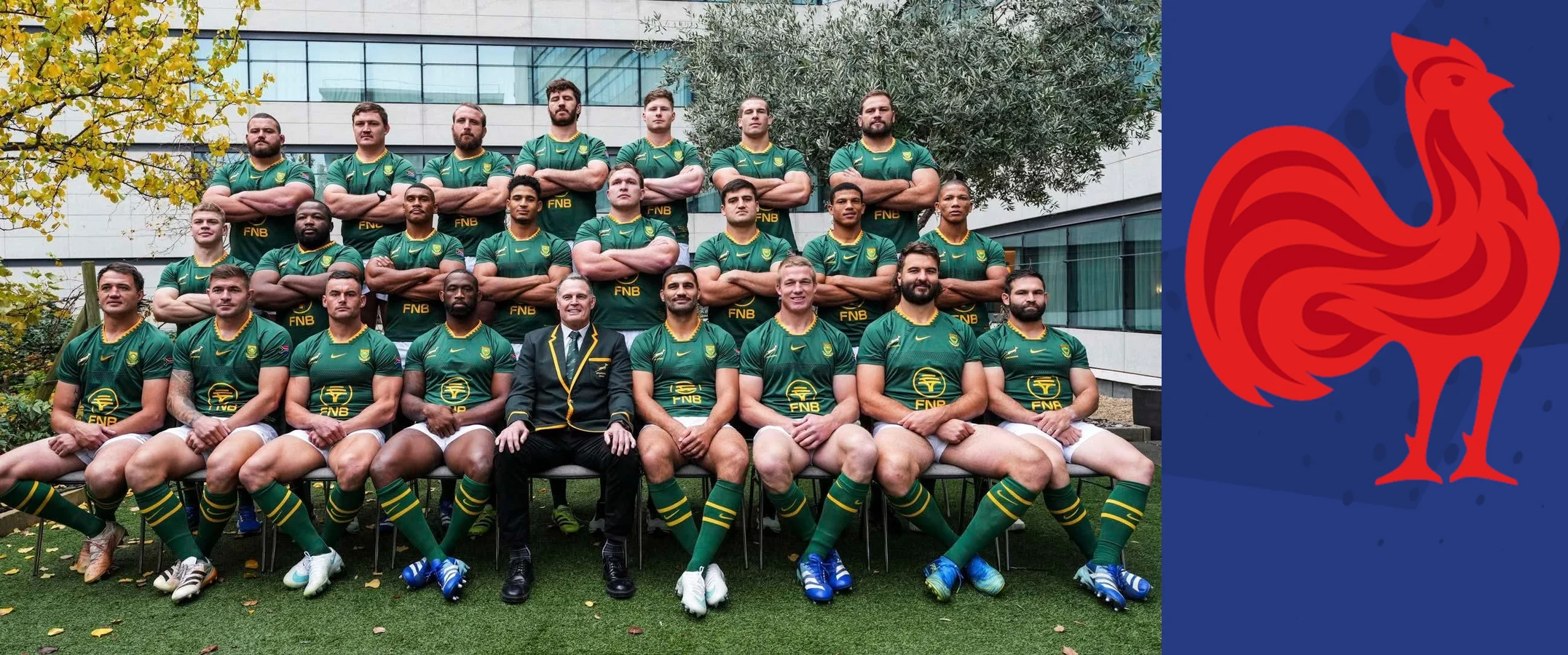
The Springbok squad in Paris · France 21–19 South Africa · Stade de France, 13 November 2026
France have beaten South Africa 21–19 at the Stade de France. The Springboks arrived in Paris as one of the most successful generations in rugby history, and left with a defeat that reputation and past World Cups cannot explain away. Beneath the result sits a question South African rugby cannot keep postponing: what happened to the transformation promises?
France beat South Africa 21–19 at the Stade de France on 13 November 2026.
France led 21–7 at half-time. The Springboks fought back in the second half, despite Jasper Wiese's yellow card being upgraded to a 20-minute red card in the 49th minute, and replacement hooker Malcolm Marx scored from a driving maul in the 71st minute. It was not enough.
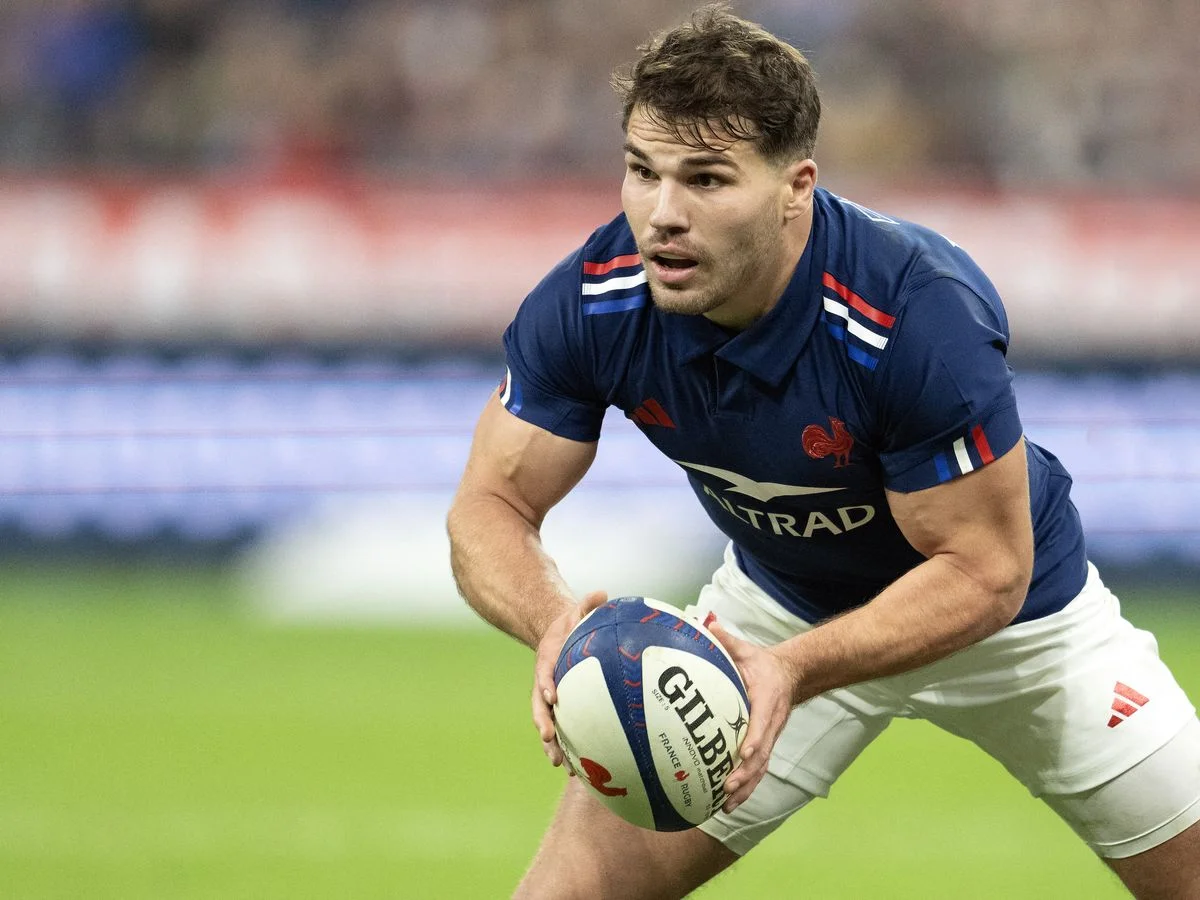
This was not an ordinary defeat. South Africa arrived in Paris as double world champions, with four wins from four in the Nations Championship and five consecutive Test victories in Paris behind them. France were without Matthieu Jalibert, Romain Ntamack and Thomas Ramos, and played Antoine Dupont at fly-half.
The defeat raises questions that cannot be answered by past World Cup victories or reputation.
South Africa has built a team that has done something few international sides in any era can claim: it has won the Rugby World Cup twice in succession. It has won four World Cups overall. It has established itself as a side capable of winning through different styles, different generations and different circumstances.
This is not simply a successful Springbok team.
This is the most successful Springbok generation in the history of the game.
That statement should not be made casually. It must be measured against the teams that came before it.
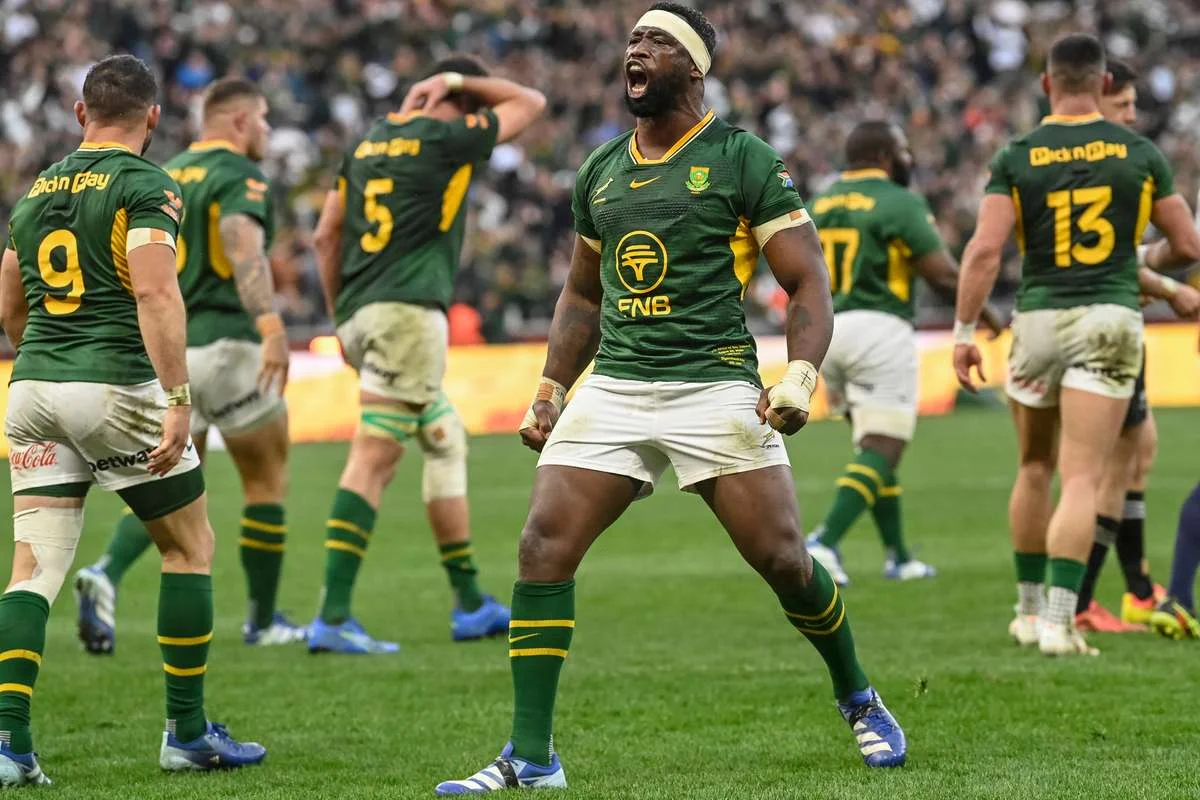
The 1995 side gave South Africa its first World Cup. The 2007 side delivered another title. The 2019 team, captained by Siya Kolisi, brought the Webb Ellis Cup home again. Four years later, Kolisi led the Springboks to a fourth title in France.
But on Friday night in Paris, that generation lost.
Its history remains extraordinary. It does not make the team immune from scrutiny after a defeat. The numbers explain both.
South Africa's World Cup history tells a remarkable story.
| Rugby World Cup | Springbok result | Captain |
|---|---|---|
| 1995 | Champions | François Pienaar |
| 2007 | Champions | John Smit |
| 2011 | Quarter-final | John Smit |
| 2015 | Third place | Jean de Villiers |
| 2019 | Champions | Siya Kolisi |
| 2023 | Champions | Siya Kolisi |
The four South African World Cup titles are 1995, 2007, 2019 and 2023. The 2019 and 2023 victories were consecutive.
There is an important distinction here. Previous Springbok teams won World Cups. This generation won two consecutive tournaments, and did so under the same captain.
That is a different kind of achievement.
Two finals. Two victories. Two World Cup titles.
And one captain.
None of that changed on Friday. And none of it changes the result in Paris.
The history between these countries stretches back to 11 January 1913, when South Africa defeated France 38–5 in Bordeaux.
There was then a gap of 39 years before their next meeting in 1952.
The rivalry has produced French triumphs, South African dominance, political controversy and two World Cup knockout matches.
The historical record entering the 13 November 2026 fixture was:
South Africa had won more than twice as many matches as France. Across those 47 Tests, the Springboks had scored 1,026 points to France's 737 — a difference of 289 points.
| Measure | South Africa | France |
|---|---|---|
| Wins | 29 | 12 |
| Points scored | 1,026 | 737 |
| Average points per Test | 21.83 | 15.68 |
| Win percentage | 61.7% | 25.5% |
France's 21–19 victory changes that record:
| Measure | Before 13 Nov 2026 | After 13 Nov 2026 |
|---|---|---|
| Completed Tests | 47 | 48 |
| South Africa wins | 29 | 29 |
| France wins | 12 | 13 |
| Draws | 6 | 6 |
| South Africa points | 1,026 | 1,045 |
| France points | 737 | 758 |
| South Africa win percentage | 61.7% | 60.4% |
| France win percentage | 25.5% | 27.1% |
South Africa still leads the rivalry comfortably. But the gap has narrowed, and the defeat now sits in the record alongside the victories.
The two World Cup meetings tell an even more dramatic story.
| Year | Stage | Result |
|---|---|---|
| 1995 | Semi-final, Durban | South Africa 19–15 France |
| 2023 | Quarter-final, Paris | South Africa 29–28 France |
| Combined | Two knockout matches | South Africa 48–43 France |
South Africa has won both World Cup meetings. The combined margin is only five points.
These were not comfortable victories. They were two exceptionally tight matches, both won by the Springboks when the consequences were enormous.
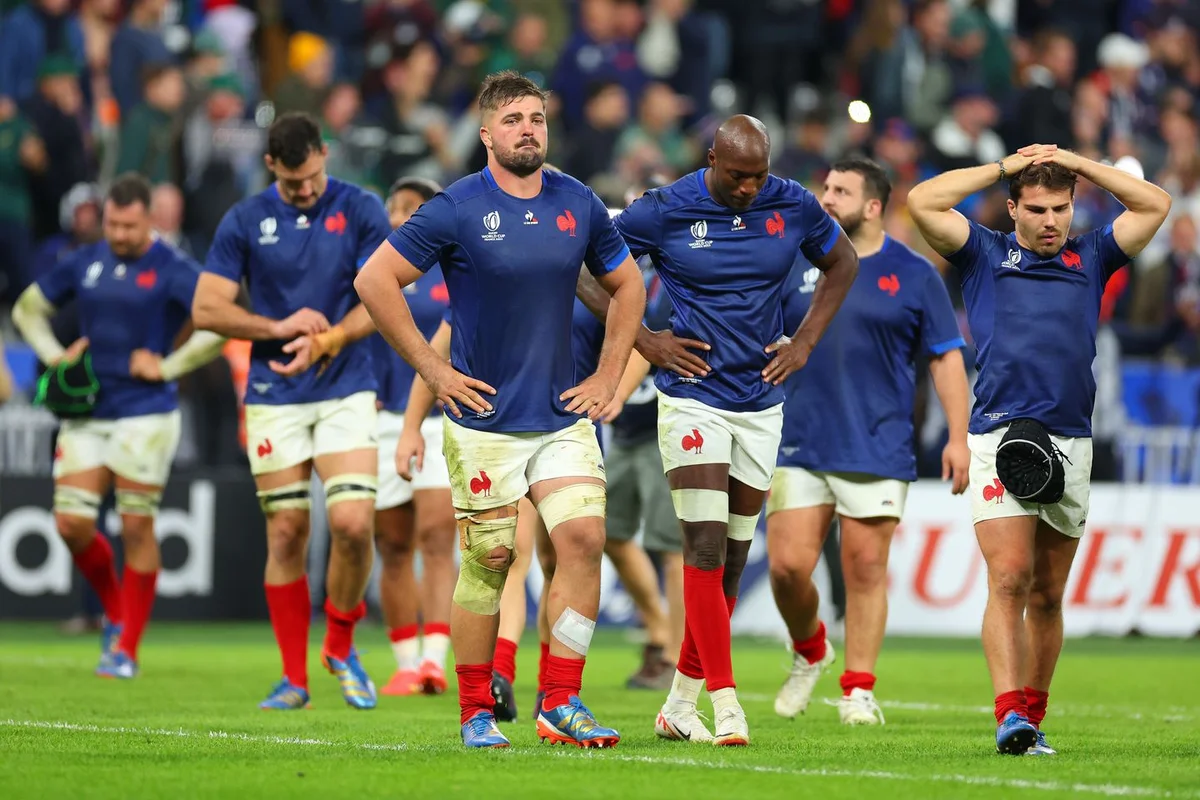
The 2023 quarter-final was particularly painful for France. The hosts were eliminated from their own World Cup by a single point.
And the rivalry's history extends beyond the scoreboard.
Before the 2026 match, South Africa had won five consecutive completed Tests in Paris:
| Date | Result |
|---|---|
| 23 November 2013 | South Africa 19–10 |
| 18 November 2017 | South Africa 18–17 |
| 10 November 2018 | South Africa 29–26 |
| 15 October 2023 | South Africa 29–28 |
| 8 November 2025 | South Africa 32–17 |
| 13 November 2026 | France 21–19 |
Before Friday, France's last victory over South Africa in Paris was in November 2005.
Friday's 21–19 defeat ends that sequence at five. It is France's first win over South Africa in Paris since November 2005.
That is not a small detail. For more than a decade, South Africa travelled successfully to one of rugby's most difficult international environments. On Friday, that run ended.
The history of the Springboks is also a history of leadership.
The captaincy has passed through generations of players who have carried the responsibility of representing South Africa.
Paul Roos. Boy Morkel. Danie Craven. François Pienaar. John Smit. Jean de Villiers. Siya Kolisi.
Each belongs to a different period of Springbok history. Each led a team under different circumstances.
But the captaincy records give us a particularly interesting comparison.
| Captain | Springbok achievement |
|---|---|
| François Pienaar | Captained South Africa to its first World Cup in 1995 |
| John Smit | Captained South Africa to the 2007 World Cup; 83 Test captaincies |
| Jean de Villiers | Led South Africa during the 2015 World Cup campaign |
| Siya Kolisi | Captained South Africa to the 2019 and 2023 World Cup titles |
John Smit remains the record-holder for the total number of Tests as Springbok captain, with 83.
But there is another measure of leadership: victories.
The research supplied for this article records that, by September 2026, Kolisi had surpassed Smit's record for the most victories as Springbok captain.
Kolisi moved one victory ahead of Smit in the supplied September 2026 record. This is a wins comparison, not a comparison of total matches captained.
That distinction matters.
John Smit captained South Africa in 83 Tests. Kolisi's total number of captaincy appearances is a separate figure, and the supplied research contains conflicting counts for his November 2026 total. We will not manufacture a precise total.
But the victory record is the important point.
Kolisi has led the Springboks to more Test victories as captain than any other man in the team's history.
And he has done so while becoming the only Springbok captain to lead South Africa to two Rugby World Cup titles.
That is an extraordinary record.
The France result does not add to that total. It is a defeat, and it goes into his captaincy record as one.
On 16 June 1991, Siya Kolisi was born in Zwide in the Eastern Cape.
He made his Springbok debut against Scotland in 2013. By 2017, he had become vice-captain.
In May 2018, he was appointed captain.
On 9 June 2018, he led South Africa against England at Ellis Park.
That appointment was historic.
Kolisi became the first Black player to captain the Springboks in a full international Test.
For 127 years of Springbok history, no Black man had been entrusted with that responsibility.
The milestone was not symbolic alone. It was followed by achievements on the field that placed him among the most successful captains in international rugby.
The 2019 achievement was historic in more ways than one.
South Africa defeated England 32–12 in the final. Kolisi became the first Black captain to lift the Webb Ellis Cup.
Four years later, South Africa defeated New Zealand 12–11.
Kolisi became the first Black captain to win two Rugby World Cups, and only the second man, after New Zealand's Richie McCaw, to captain a team to two World Cup titles.
There is a temptation to describe Kolisi's achievement only through the lens of race. That would be incomplete.
He must also be judged as a rugby captain.
He has led South Africa to more Test victories than any previous Springbok captain. He has led the team to two World Cup titles. He has captained the side through some of the most consequential matches in its history.
His leadership has become part of the team's sporting record.
The historic first made him a landmark figure. The victories made him one of the greatest.
One defeat does not change that. Nor does it make him responsible, on his own, for what happened in Paris.
To understand Kolisi's significance, we must look at the players who came before him.
The history of Black leadership in South African rugby did not begin in 2018. It was preceded by decades of exclusion, resistance and milestones that must be recognised.
But the terminology matters. Apartheid-era racial classifications and modern descriptions of identity are not interchangeable.
First non-white Springbok Test player
Second non-white player in the documented sequence
First non-white Springbok since Tobias
First Black captain of a senior Springbok representative side
First Black Springbok head coach
First Black Springbok Test captain
Errol Tobias made his debut against Ireland at Newlands on 30 May 1981. South Africa won 23–15. Tobias went on to earn six Test caps between 1981 and 1984.
Chester Williams became a prominent member of the 1995 World Cup-winning side. He was particularly memorable for scoring four tries in the quarter-final against Western Samoa.
In 2006, Chiliboy Ralepelle captained a Springbok representative side against a World XV in Leicester. He was 20 years old.
That match did not have Test status. It is therefore important not to confuse his achievement with Kolisi's 2018 milestone.
The distinction is clear:
Both achievements matter.
But Kolisi's appointment carried the responsibility of leading the national team in official Test rugby — a responsibility that had been denied to Black players throughout the first 127 years of Springbok history.
The French side has its own history of captains from diverse backgrounds.
Thierry Dusautoir is one of France's most successful captains, with 56 captaincy appearances in the supplied historical record. He led France through some of its most important modern campaigns.
However, we must be careful about assigning racial identity based on appearance, ancestry or assumption. The research available to us does not establish a definitive first Black French men's Test captain.
Abdelatif Benazzi, who captained France 15 times, was born in Morocco. His North African heritage does not, by itself, establish that he was Black.
The historical comparison should not manufacture a French equivalent simply to make the table look complete.
What we can establish is that the South African milestone is specific and extraordinary: Kolisi was the first Black man to captain the Springboks in a Test, and he went on to lead them to two World Cup titles.
And this is where the story becomes more complicated.
Because the same team that has produced extraordinary sporting success also presents a serious question about representation.
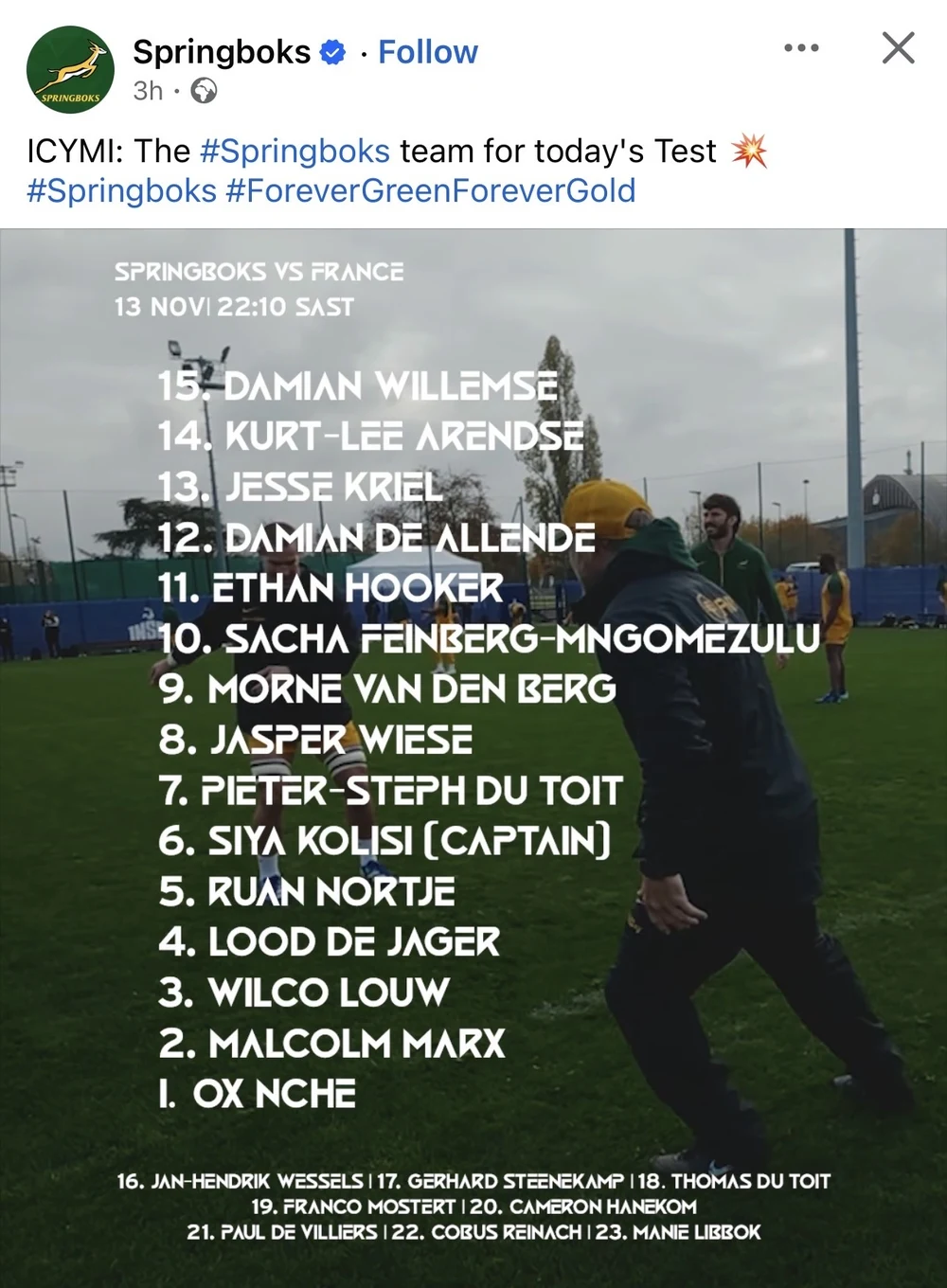
The Springbok matchday 23 selected for France contains:
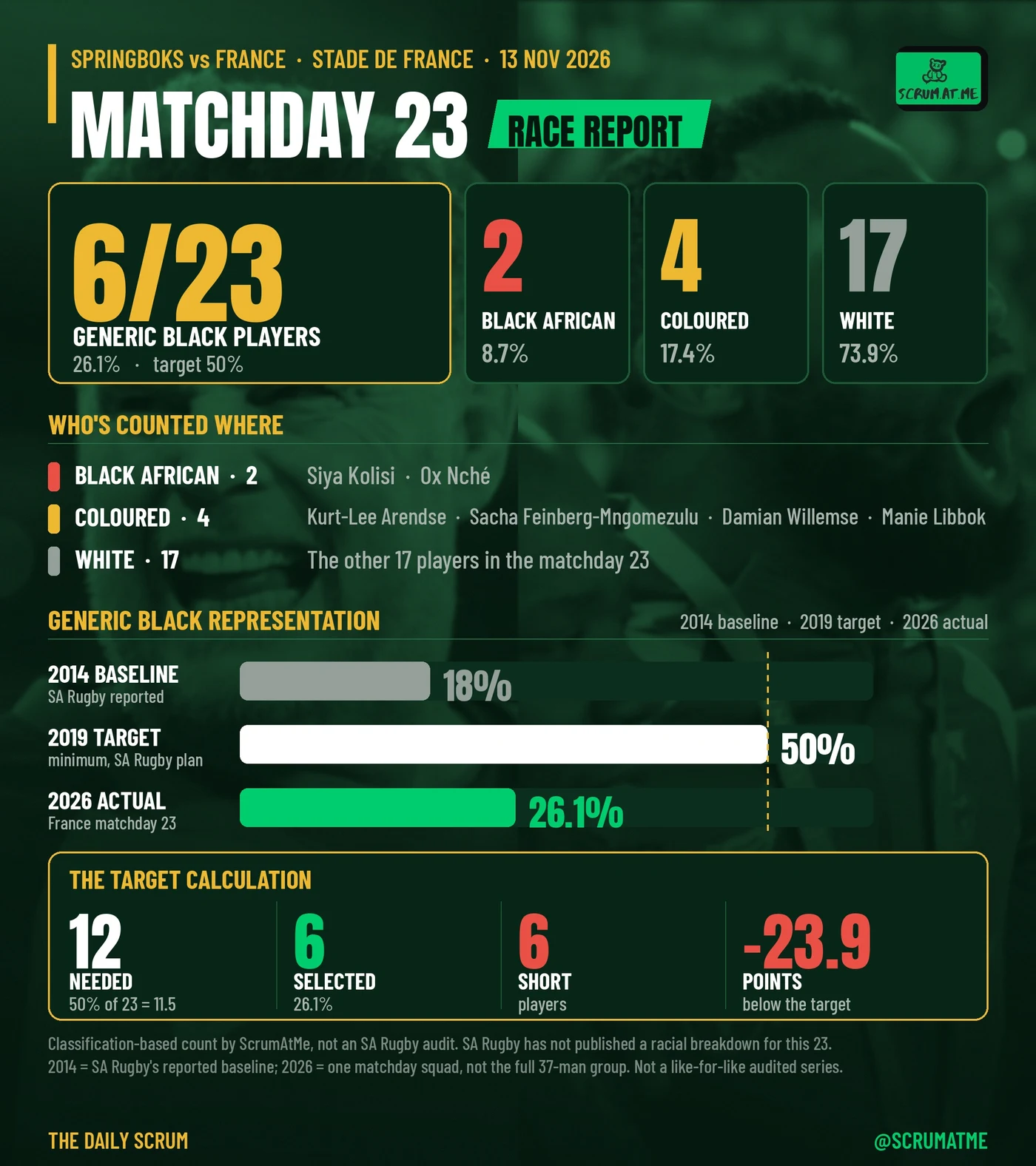
Black African — 2
Coloured — 4
White — 17
The remaining 17 players in the matchday 23.
This is a classification-based count of the selected matchday 23, not an official SA Rugby demographic audit. The six Generic Black players are the two Black African and four Coloured players counted together.
Less than an hour before kick-off, the Springboks changed their entire front row. Jan-Hendrik Wessels, Gerhard Steenekamp and Thomas du Toit moved into the starting XV. Ox Nché, Malcolm Marx and Wilco Louw moved to the bench. No reason was given in the announcement.
The change did not alter the matchday 23. The same 23 players were selected, so the 6/23 count stands. What changed was who started.
| Measurement | Black African | Coloured | Generic Black | Players |
|---|---|---|---|---|
| Matchday 23 | 2 | 4 | 6 (26.1%) | 23 |
| Starting XV | 1 | 3 | 4 (26.7%) | 15 |
| On the field at kick-off | 1 | 3 | 4 | 15 |
At kick-off, Siya Kolisi was the only Black African player on the field for South Africa. Ox Nché, the other Black African player in the matchday 23, started on the bench.
Counting Coloured players as well, four Generic Black players started: Siya Kolisi, Damian Willemse, Kurt-Lee Arendse and Sacha Feinberg-Mngomezulu. Ox Nché and Manie Libbok were among the replacements.
One Black African player on the field is not the same as one Generic Black player on the field. The two classifications must be kept separate.
We have not yet confirmed the substitution minutes for the rest of the match. Until the official substitution timeline is confirmed, we will not state how the on-field count changed after kick-off.
The picture is stark.
Only two Black African players in a 23-man Springbok matchday squad.
Four additional players classified as Coloured.
Seventeen white players.
This is not an argument against the players selected. Every player who earns a Springbok jersey deserves respect. Their ability, commitment and achievements should not be diminished.
But selection must also be examined in the context of the transformation commitments South African rugby made.
And those commitments were not made yesterday.
In 2014, SA Rugby's transformation plan recorded a Generic Black representation baseline of 18%.
It set a target of at least 50% Generic Black representation by 2019.
That target is the reference point against which the current matchday selection must be examined.
| Measurement | Generic Black representation |
|---|---|
| 2014 baseline | 18% |
| 2019 target | 50% |
| 2026 France matchday 23 | 26.1% |
The 2026 figure is 23.9 percentage points below the 50% target.
In a 23-player matchday squad, 50% would require at least 12 Generic Black players.
The actual count is six.
| Matchday calculation | Players |
|---|---|
| Players required to reach 50% | 12 |
| Generic Black players selected | 6 |
| Difference | 6 |
That is the issue.
The 2014 baseline was 18%. The target was 50%. The current matchday 23 count is 26.1%.
The comparison must be treated carefully: the 2014 figure is SA Rugby's reported baseline, while the 2026 figure is our count of one matchday squad. They are not identical measurements, and this is not an audited time series of every Springbok selection.
But the gap is large enough to demand an explanation.
The Springboks have achieved extraordinary success. The transformation figures have not reached the target.
Those two facts can exist at the same time.
There is also a second distinction. The 26.1% figure describes the matchday 23, not the players on the field. Selection is one measure. What selection translates into once the match is being played is another.
There is another concern.
The issue is not only the composition of one senior matchday squad. It is also the composition of the next generation of players coming through the system.
The selection of younger players matters because today's young Springboks are tomorrow's established internationals.
In the six younger selections identified in the research for this article, only one was Black.
That deserves attention.
If the next generation continues to be selected from a pool that does not reflect the transformation commitments, the problem will not correct itself simply because the current generation eventually retires.
Transformation is not a slogan that can be revisited every few years. It requires a development pathway, access to opportunity, consistent selection and accountability for results.
The question is not whether the Springboks should select players who are not ready.
They should not.
The question is whether the structures responsible for identifying, developing and preparing future Springboks are delivering the opportunities and outcomes that the commitments were supposed to produce.
And if they are not, who is responsible for correcting that?
Let's be clear.
We celebrate Rassie Erasmus. We celebrate Siya Kolisi. We celebrate the players who have delivered four World Cup titles and two consecutive championships.
We have celebrated this team's ability to win in Paris. On Friday, it did not.
But admiration cannot become immunity from scrutiny.
A successful coach can still be questioned about selection. A successful administration can still be asked whether it has fulfilled its commitments. A historic captain can be celebrated while the system around him is examined.
The transformation question is not an accusation against an individual player.
It is a question about the national rugby system.
Siya Kolisi has described the coach's priorities in his own words:
“Coach Rassie said from day one: winning, transformation, building squad depth.”
Those are the stated objectives. Against France, the result was a defeat, the matchday 23 counted six Generic Black players out of 23, and only one Black African player started.
One match does not prove that the transformation programme has failed. But it is fair to ask whether the selection outcomes, and the opportunities on the field, are consistent with the objectives the coach himself set out.
South African rugby made commitments. It set targets. It established a framework intended to change representation in the national game.
More than a decade later, the figures in this matchday squad do not demonstrate that the 50% target has been achieved.
The coaching staff, development structures and rugby administration must be able to explain why.
And the question does not become less important when the team is winning, or less urgent when it loses.
Because success gives South African rugby the platform, resources and international standing to build a stronger future. It should not be used as a reason to avoid difficult conversations.
There is something particularly significant about the contrast at the centre of this story.
Siya Kolisi is the first Black man to captain the Springboks in a Test.
He has led South Africa to two Rugby World Cup titles.
He has surpassed John Smit's record for the most victories as Springbok captain.
He has become one of the most successful leaders in the history of international rugby.
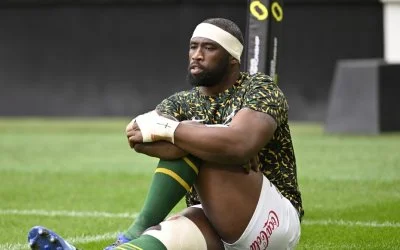
And yet, in the matchday 23 for this defeat to France, he was one of only two Black African players — and, at kick-off, the only Black African player on the field.
That is a remarkable contradiction.
Kolisi's achievement should be celebrated without qualification. He has earned his place in Springbok history through leadership, resilience and results.
But his achievement should also remind us of how much work remains.
The objective of transformation was never supposed to be satisfied by one historic appointment. It was meant to change the opportunities available to generations of South African players.
The measure of progress cannot simply be that Siya Kolisi became captain.
It must also be whether more Black South African players are being developed, selected and trusted to become the next Siya Kolisi — and the next generation of Springbok leaders.
Two realities. One Springbok team.
South Africa should be proud of this Springbok team.
It should be proud of Siya Kolisi.
It should celebrate the victories, the records and the extraordinary achievement of winning back-to-back World Cups.
But pride in the Springboks must also mean caring about the future of South African rugby.
The 2014 transformation target was not a decorative statement. It was a commitment.
The 2026 figures deserve an answer.
A defeat does not erase the Springboks' history. A defeat does not diminish Siya Kolisi's historical achievement. A defeat does not, by itself, establish why the team lost.
But neither past success nor the prestige of the jersey should prevent scrutiny of selection, representation and development.
We can celebrate the greatest Springbok generation in history and still demand a better transformation record. In fact, we should do both.
Winning does not change the numbers. Losing does not make the numbers disappear.
ScrumAtMe — We investigate FIRST. We cook SECOND.