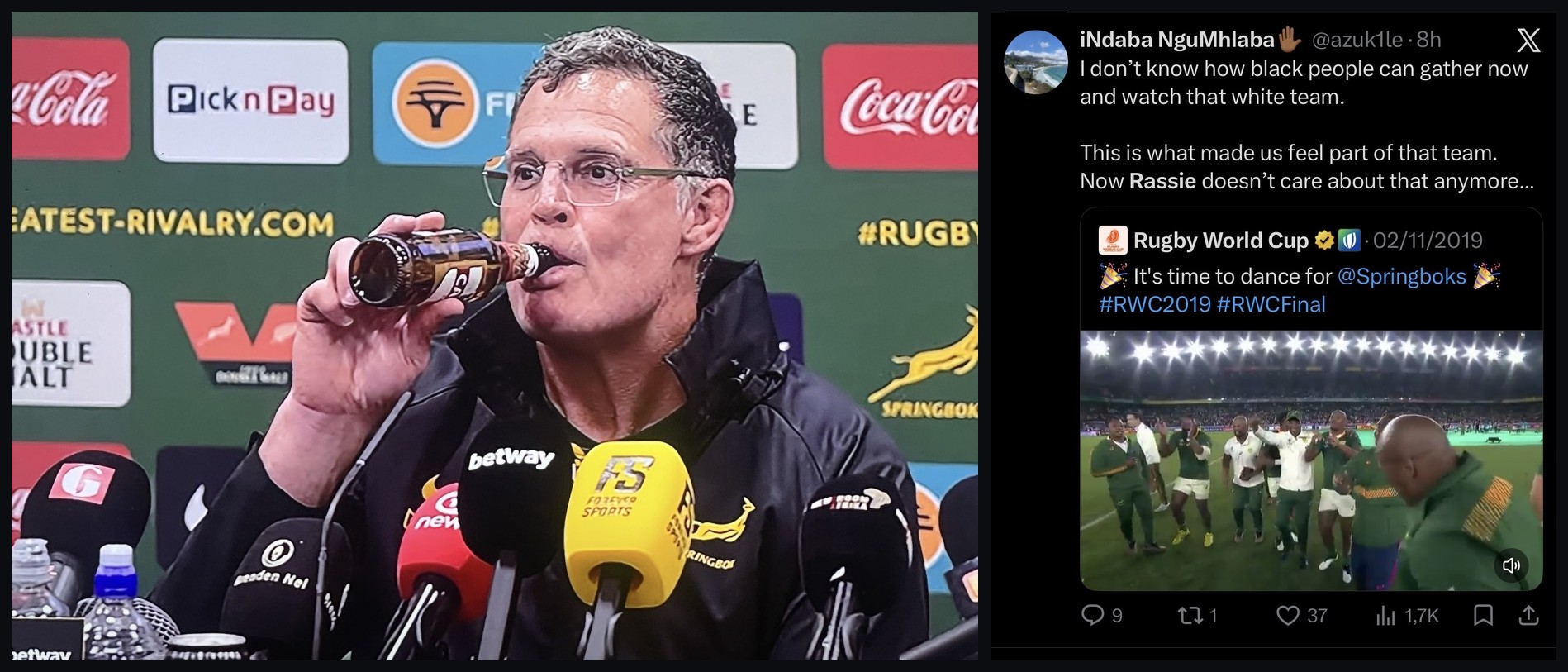
Okay nahh, before this thing gets outta hand 😭
Somebody has put the R-word next to Rassie Erasmus and now everybody got evidence. Unc got team sheets from 2019. The skreets got screenshots. Somebody's cousin has already counted the whole squad twice. My guy, we are TWO posts away from somebody analysing who Rassie follows on Instagram 💀
So we did something dangerous.
WE ACTUALLY CHECKED.
Not whether Rassie "looks racist." What does that even mean 😭 Not whether somebody got a bad feeling after the team announcement. We went through the selections, the caps, the injuries, the players who disappeared, the players who came BACK, and SA Rugby's own transformation numbers.
And there's a reason this conversation isn't going away.
Because some of the claims fall apart immediately. Some have perfectly normal rugby explanations. But some?
nahhh... those need explaining.
Especially when you get to Lukhanyo Am.
42 caps.
Jesse Kriel?
90.
Same generation.
And somehow that's only the BEGINNING of the story.
So don't gimme the "Daily Scrum called Rassie racist" speech.
WE DIDN'T.
We're doing what Unc should've done before posting.
CHECK THE RECEIPTS.
SIGN 1 — THE CAPS GAP THAT STARTED THIS WHOLE THING
The post that really lit the fuse was simple.
Lukhanyo Am: 42 Test caps.
Jesse Kriel: 92 Test caps.
And underneath it, the accusation was basically that Am had been denied opportunities while Kriel had been given them.
First problem.
92 isn't right.
At the first Test against New Zealand in August 2026, Kriel was on 90. So we're correcting that immediately because if we're going to investigate selection, we ain't starting by selecting our own numbers 😭
But 90 doesn't exactly make the comparison disappear.
Am has 42.
Kriel has 90.
Am was born on 28 November 1993. Kriel was born on 15 February 1994. They're separated by roughly 14 months and Kriel is actually the younger man.
That's the part fans see.
Same position.
Same generation.
More than double the caps.
Now there is important context.
Kriel made his Springbok debut against Australia on 18 July 2015.
Am debuted against Wales on 2 December 2017.
That's roughly a two-and-a-half-year head start, and pretending that doesn't matter would be nonsense. Kriel had years of Test windows before Am had even entered the picture.
Cool.
Except now we've opened another question.
Kriel debuted at 21.
Am debuted at 24.
And once you know the player Am eventually became, you can't just walk past that.
Why did one same-generation centre enter international rugby three years earlier than the other?
Hold that.
Because this thing goes further back than Rassie.
SIGN 2 — 42 CAPS LOOKS DIFFERENT WHEN YOU READ THE CV
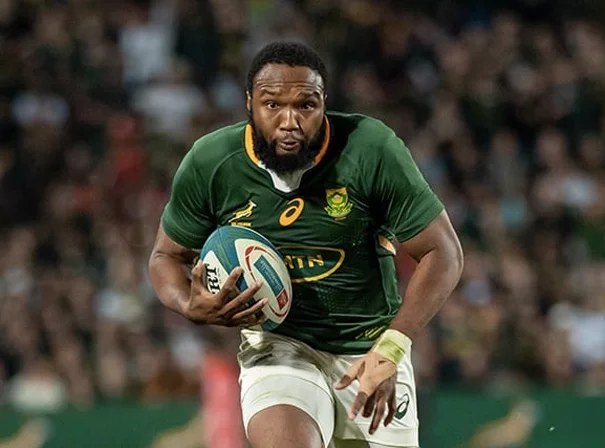
Now open Am's file.
This is where fans start making noise.
In 2019, Lukhanyo Am was nominated for World Rugby Player of the Year.
The WORLD one.
Not some "Top 10 centres according to Rugby Twitter" list Unc made at 2AM 😭
He was on the official shortlist for the biggest individual award in the sport.
Then go to the 2019 World Cup final.
South Africa had never scored a try in a World Cup final.
Makazole Mapimpi changes that.
And the final pass comes from Am.
Then in 2021, South Africa A plays the British & Irish Lions.
Who gets the armband?
Am.
He was also a regular Springbok vice-captain to Siya Kolisi and had captained the Sharks from 2020.
That's why this isn't just somebody counting caps for fun.
Am's peak standing in world rugby was enormous.
But now let's keep Jesse out of the crossfire.
Because the minute this conversation starts, people act like one man has to be trash for the other man's numbers to be questioned.
Nahh.
Kriel has his OWN file.
Durability.
Defensive leadership.
Years inside the Springbok system.
And alongside Damian de Allende, he became part of the most-capped Springbok midfield partnership in history.
So don't gimme the "you just think Am is better than Jesse" speech.
That's not the investigation.
You can believe Kriel deserved every opportunity he got and STILL ask how a World Player of the Year nominee from the same generation ended up with barely half his caps.
Those two things can sit at the same table.
And right now they're staring at each other 😭
SIGN 3 — YES UNC, AM WAS INJURED
Now we get to the first BIG explanation.
And it's real.
Am's body has cost him rugby.
In September 2022, he injured his knee against Australia in Sydney. He underwent surgery and his season was finished.
Then August 2023.
Another injury against Argentina.
That one came at the worst possible time because it knocked him out of South Africa's original World Cup squad.
He eventually flew to France as injury cover for Mapimpi, but played zero minutes at the tournament.
Then came rib and shoulder problems in 2024.
Another knee knock followed at the Sharks in May 2025.
And Am himself acknowledged how difficult the recovery had been. Speaking in 2023, he said: "Long-term injuries are tough. I am not where I was before the injury."
Meanwhile Kriel has been ridiculously durable.
The record we reviewed contains only one notable Test withdrawal through injury across roughly a decade.
That's a MASSIVE difference between two players competing for international minutes.
So yes.
The injury explanation is legitimate.
We're not throwing it away because it messes with the investigation.
But don't gimme the "case closed" speech either.
Because injuries explain the Tests Am missed while injured.
They don't automatically explain everything before and after them.
Kriel's head start began in 2015.
Am's major injury run came years later.
And after those injuries, Am eventually returned to Test rugby. He was fit enough to play and start during the 2024 Rugby Championship.
Then 2025 arrived.
And Am disappeared from the Springbok picture again.
So the question isn't whether injuries mattered.
Obviously they did.
The question is:
how much of 90–42 do they actually explain?
SIGN 4 — THE No.13 JERSEY CHANGED HANDS WHILE AM WAS HURT
This part might be the easiest selection decision to understand.
Am gets injured in August 2023.
South Africa needs another 13.
Kriel gets the jersey.
And Kriel performs.
He scores twice during the World Cup, becomes an important part of South Africa's defensive system and finishes the tournament with another World Cup medal.
My guy, if you're Am watching that from the side, that's a TERRIBLE time for Jesse to remember he's nice 😭
Reporting after the tournament was explicit: Kriel had seized the No.13 jersey and wasn't simply going to give it back without a fight.
Fair.
That's professional rugby.
The jersey belongs to whoever earns it.
But this is where the fans' question gets more specific.
Am returned.
He played Test rugby again.
He started during the 2024 Rugby Championship.
Yet by 2025, he wasn't merely sitting behind Kriel waiting for another opportunity.
He was omitted from the entire Rugby Championship squad.
Then the year-end tour too.
So nobody needs to explain why Kriel got No.13 in 2023.
We KNOW why.
The question is what happened once Am was available to fight for it again.
Was there genuinely a route back?
Was Kriel simply better for what the Springboks wanted?
Was Am's post-injury level no longer where the coaches needed it?
Those are rugby explanations.
But they're explanations we actually need.
Because "he got injured in 2023" and "he was outside the squad in late 2025" are not the same sentence.
SIGN 5 — THEN AM PACKED HIS BAGS
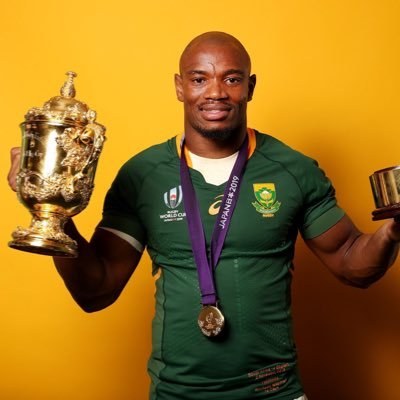
November 2025.
After nine years with the Sharks, Am leaves with immediate effect and signs for Mitsubishi Dynaboars in Japan.
He's 31.
Now there is nothing unusual about a 31-year-old Springbok taking a Japanese contract.
The Cluuuurb has been open over there for YEARS 😭
If Am had decided his international career was finished and wanted the next chapter, there wouldn't be much here.
But that wasn't how his move was framed.
He was reportedly hoping to reignite his Test career.
That's what makes this relevant.
He wasn't walking away from the Springboks.
He was trying to find another road BACK.
World Cup winner.
Former Bok vice-captain.
Former Sharks captain.
World Player of the Year nominee.
Still chasing another opportunity at 31.
So when fans use the words "phased out," this is probably the cleanest piece of the timeline they're looking at.
Am didn't leave and THEN stop getting selected.
The selection stopped first.
That doesn't tell us why.
But it tells us the order.
And the order matters.
SIGN 6 — AND NOW THE SIMPLE THEORY STARTS HAVING PROBLEMS
Okay.
Time to mess up our own story 😭
Because there's a pretty important fact sitting in the middle of Am vs Kriel.
Jesse Kriel is himself commonly classified as a player of colour in South African rugby reporting.
So if somebody's entire argument is:
black player out → white player in
then Am vs Kriel does NOT give you that.
Simple.
We're not changing Jesse's identity because the argument needs a villain.
Then look at the wider Springbok picture.
Canan Moodie.
Sacha Feinberg-Mngomezulu.
Aphelele Fassi.
Kurt-Lee Arendse.
Grant Williams.
All players of colour.
All backed inside the Erasmus Springbok environment.
That is not a small complication.
It's fundamental.
Because if somebody asks:
"Does Rassie Erasmus back players of colour?"
the team sheets themselves say yes.
So now the original theory has to become more specific or it falls apart.
Maybe the question isn't whether players of colour are being selected.
Maybe fans are questioning which established players receive sustained backing, which get opportunities to recover their position, which are recalled after falling out, and which eventually stop appearing.
And maybe THAT turns out to have perfectly normal rugby explanations too.
Cool.
Let's keep going.
FINDING 7 — THE THREE-YEAR HEAD START DIDN'T BEGIN WITH RASSIE
Now remember the debut ages.
Kriel: 21.
Am: 24.
If we're investigating Erasmus, there's a problem.
Am debuted in December 2017.
Rassie took over the Springboks in 2018.
So we cannot put Am's delayed international breakthrough on Erasmus.
Nahhh, dates got hands 😭
That part of the case ends right there.
But the underlying comparison still tells us something interesting about South African rugby.
Kriel came through Maritzburg College, represented the Junior Springboks, moved through the Blue Bulls/Bulls system and reached the national team at 21.
Am came through Border, then the Southern Kings, then the Sharks, before finally reaching the Springboks at 24.
And now we know what Am became.
World class.
So the talent clearly existed.
The question is why the road took longer.
Not:
"Why did Rassie delay Am?"
He didn't.
The timeline rules that out.
The real question points somewhere else.
FINDING 8 — TWO ROADS TO THE SAME SPRINGBOK JERSEY
Put the pathways next to each other.
Kriel:
Maritzburg College → Junior Springboks → Bulls → Springboks at 21.
Am:
Border → Southern Kings → Sharks → Springboks at 24.
One player came through a traditional elite rugby pathway.
The other came through Border and the Southern Kings before reaching a major franchise.
Same generation.
Same position.
Eventually the same Springbok jersey.
That raises a much bigger question than one coach.
Does elite black talent emerging from places like Border and the Eastern Cape reach South Africa's national development pipeline at the same speed as talent already inside the country's traditional rugby structures?
That's not an accusation.
It's not even primarily a Rassie question.
It's a pathway question.
And sometimes an investigation starts looking at one guy and ends up finding the system standing behind him.
Tell me that's not worth looking at 👇
FINDING 9 — THEN FANS STARTED ADDING NAMES
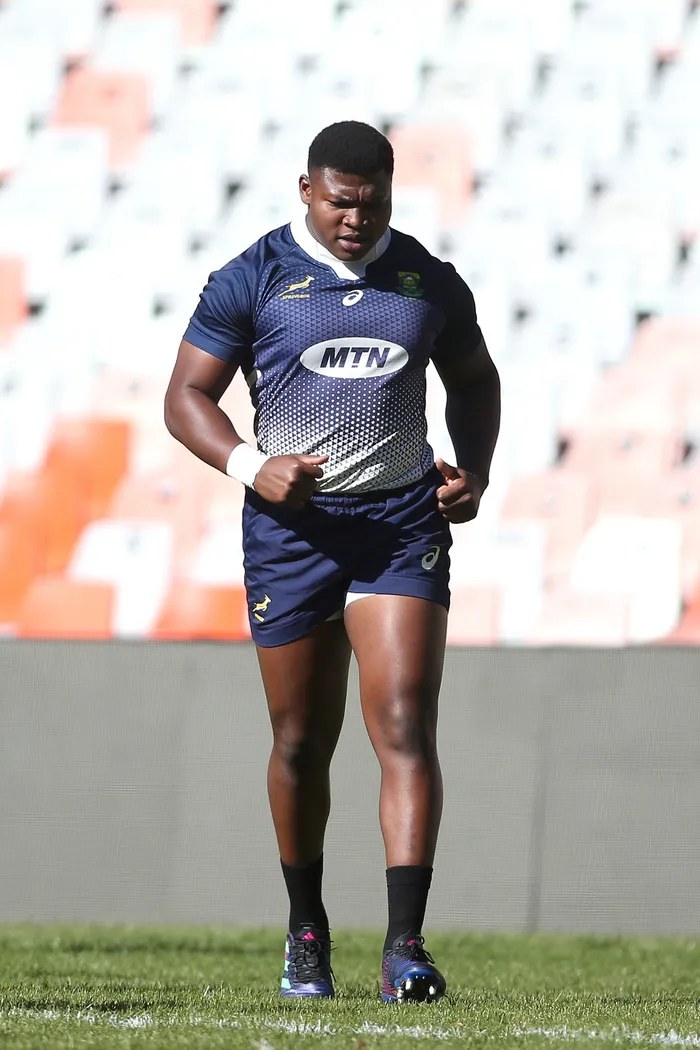
Now this is where things can get LOOSE.
Because once people believe they've spotted a pattern, suddenly every player of colour who hasn't been selected since 2022 gets added to the evidence folder.
Nahh.
One at a time.
SBU NKOSI
16 caps.
9 tries.
2019 World Cup winner.
Last Springbok involvement in 2021.
On the surface, that's another prominent player of colour who disappeared from the national setup.
Then you read the rest of the file.
In December 2022, the Bulls reported Nkosi missing after weeks without contact. He was later found safe and spoke publicly about the mental pressure he had been experiencing.
Then came a positive test for an anabolic steroid in May 2024 and a three-year doping ban.
That's not a clean selection story.
So we don't use it like one.
EMBROSE PAPIER
Papier is different.
He was selected in Erasmus's first Springbok squad in 2018 and made his first Test start against Scotland that November.
Then he went eight years without another Test.
Eight YEARS.
Bro got outside the Cluuuurb and the bouncer forgot his face 😭
Except here's what matters:
he came back.
Papier was recalled in 2026 after an excellent URC season.
Erasmus's explanation was that sometimes a player isn't performing badly and isn't below Springbok level; there are simply other players performing better.
That's important evidence because Papier's story shows that falling out of the Springbok picture does not necessarily mean the door is permanently closed.
NTUTHUKO MCHUNU
Same problem for the simple theory.
Mchunu debuted against Wales in 2022.
Three caps.
No Tests in 2023.
Moves from the Sharks to the Stormers.
Strong URC season.
Then in 2026?
BACK.
Another player of colour who faded from the picture and was recalled.
WANDISILE SIMELANE
Now Unc, don't start 😭
Simelane is often included in conversations about Springboks who disappeared.
But there's a correction.
He never became a capped Springbok.
He was selected in the 2021 British & Irish Lions series squad but never received a Test debut.
That's still interesting if we're discussing opportunities.
But he isn't a former capped Bok who was dropped.
Facts first.
MANIE LIBBOK
Now we get to another big name.
Libbok was South Africa's first-choice flyhalf through the pool stages of the 2023 World Cup.
Then came the England semi-final.
31 minutes.
Off.
Pollard enters.
And Pollard keeps the jersey.
Erasmus later publicly discussed Libbok's goal-kicking problems while making clear that he still rated his general play.
By August 2026, Libbok was behind Sacha Feinberg-Mngomezulu and had signed for Japan.
Again, there is a documented rugby explanation.
Goal-kicking.
So don't gimme a graphic with six faces and tell me six faces automatically equal one cause.
They don't.
Nkosi's story is different.
Papier came BACK.
Mchunu came BACK.
Simelane was never capped.
Libbok has an identified performance issue.
Am has injuries and a world-class incumbent at 13.
The pattern fans see is real in one narrow sense: several prominent players of colour have moved out of the central Springbok picture at different points.
But the reasons are not the same.
That's the complication.
And we're keeping it.
FINDING 10 — THEN SA RUGBY'S OWN NUMBERS SHOWED UP
Okay now THIS is different.
Put the screenshots down.
Close X.
Tell Unc he can take lunch 😭
Because we have actual reported numbers from SA Rugby's own transformation audit.
For the 2023 Rugby World Cup squad, the target for "generic black" representation was 54%.
The achieved figure was:
38%.
The target for "ethnically black" representation was 27%.
The achieved figure was:
16%.
During the 2023 Rugby Championship, the figures were 39% generic black and 13% ethnically black.
And according to SA Rugby's own report, the Springboks did not achieve the transformation targets in any of the three series in which they played in 2023.
Now everybody behave.
Because this does NOT say:
RASSIE ERASMUS IS RACIST.
That conclusion does not follow automatically from those numbers.
What the numbers DO establish is that the senior Springbok team fell short of SA Rugby's own written representation targets.
That's factual.
The long-term target on the books is 60% black/brown representation by 2030.
So naturally we wanted to see what happened next.
2024.
2025.
2026.
Equivalent official figures did not surface in the material collected for this investigation.
And now we've got a question that doesn't require anybody to accuse anybody of anything.
WHERE THE NUMBERS AT??
Publish them.
Then we can actually compare.
FINDING 12 — WHY THIS QUESTION HITS DIFFERENT IN SOUTH AFRICA
Now we gotta talk history.
Because South African rugby doesn't get to have a conversation about race and selection like the jersey arrived yesterday.
For most of the 20th century, black and coloured players were excluded from Springbok selection under apartheid.
Errol Tobias became the first black Springbok in 1981.
Just sit with that date.
1981.
That's not some dusty story from the ancient skreets.
That's living memory.
Then came the post-apartheid controversies.
In 2003, Geo Cronjé was removed from a pre-World Cup camp following the controversy involving coloured teammate Quinton Davids and room-sharing. But the formal Judge Edwin King inquiry later concluded that it "was not a racist affair."
Then 2018.
Ashwin Willemse walks off a live SuperSport set with Nick Mallett and Naas Botha.
Willemse later says:
"I fundamentally believe that this issue was rooted in racism."
An independent investigation clears Mallett and Botha.
The SA Human Rights Commission later closes the case.
Those examples don't prove anything about Rassie Erasmus.
That's not why they're here.
They're here because they explain why South African rugby fans don't necessarily see 42 vs 90 as just two numbers.
The jersey has history.
Selection has history.
Opportunity has history.
And once that history exists, people are going to ask whether today's decisions are completely separate from yesterday's patterns.
Sometimes they will be right.
Sometimes they'll be completely wrong.
But they're gonna ask.
SO... IS RASSIE ERASMUS RACIST?
After going through all of this?
WE DON'T HAVE THE EVIDENCE TO SAY THAT.
And that's where we stay disciplined.
We are not taking a selection pattern and turning it into a judgment about a man's character.
We are not taking SA Rugby missing transformation targets and pretending the report says something it doesn't.
We are not taking Am's 42 caps and pretending injuries never happened.
And we're not pretending players like Papier and Mchunu weren't brought BACK because that would make the pattern cleaner.
Nahh.
EVERYTHING STAYS.
Because after everything stays, there are still questions.
Lukhanyo Am has 42 caps.
Jesse Kriel reached 90.
Am was a World Player of the Year nominee.
He produced one of the defining moments of the 2019 World Cup final.
He captained South Africa A.
He was a Bok vice-captain.
Then injuries hit.
Kriel took the jersey and performed.
Am returned.
Then Am disappeared from the squad.
Then Am left South Africa while still trying to revive his Test career.
Meanwhile some players of colour who fell out of the setup came back.
Others didn't.
New players of colour continue to be backed.
And SA Rugby's own audit says the senior Springboks missed their black-representation targets in 2023.
So maybe every individual decision has a completely legitimate rugby explanation.
That's possible.
But then answer the questions.
How much of 90–42 is injury?
Why did Am enter Test rugby three years later?
Once he returned to fitness, how much opportunity did he actually have to reclaim No.13?
Why did his road eventually lead to Japan while he was still chasing another Springbok opportunity?
Why do Papier and Mchunu make it back while others don't?
What do the 2024, 2025 and 2026 transformation numbers say?
And when every individual case can be explained on its own, does the bigger pattern disappear—
or nahh? 👇
We're not making the call.
We're putting the whole file on the table.
Who agrees?? 👇
SAVE this & tag a Bok fan.