
The All Blacks Have Finally Come Back to South Africa for a Proper Tour — Their First Since 1996 — and They've Walked Into a Country That Is Ranked Number One in the World, Holds the Heaviest Win in the Fixture's History, Owns This Stadium 9-6, and Has a Head Coach Who Brings Retired Referees to Press Conferences: The Complete ScrumAtMe Dossier on Rugby's Greatest Rivalry
Thirty years. That is how long this country has waited for the All Blacks to come here properly — not for one Test squeezed between airport lounges, not for a World Cup pool game, but a full tour, the old-fashioned kind, where the tourists roll through the provinces and then face the Springboks four times. The last one was 1996, and if you were there you have told everyone about it approximately nine thousand times. Now it's back. They've called it Rugby's Greatest Rivalry, which is the rare piece of marketing that undersells the thing. The first Test is Saturday, 22 August, at Ellis Park. Set a reminder. Cancel plans. Phone your mother now so you don't have to phone her later.
And understand what this actually is, because the stakes have arranged themselves almost too neatly. South Africa are ranked number one in the world on 93.96 points. New Zealand are number two on 92.28. Ireland, France and England are behind them, watching. If the All Blacks win at Ellis Park, they take the number one ranking off us on Saturday night. Not later in the series — Saturday. There is no such thing as a friendly Test between these two, but this is the first time in a long while that the actual trophy cabinet and the actual world order are both on the table in game one of a four-match tour.
 Ardie SaveaNew Zealand · File photo · 109 Test caps. Captains the All Blacks at Ellis Park on Saturday in his 110th Test — and his 18th against South Africa.
The ledger between them is the oldest and heaviest in the sport. One hundred and ten Tests since 1921. New Zealand lead it 63 to 43 with four draws, and they lead the points 2,225 to 1,785 — allblacks.com is already calling Saturday number 111, which is the sort of forward planning we simultaneously admire and resent. But split it by geography and the picture changes completely. In New Zealand: 48 played, 34 to them, 11 to us, three draws. Grim. On South African soil: 54 played, and the Springboks lead it 28-25 with one draw. On neutral ground: eight played, four apiece — and one of those four happens to be a World Cup final we'll get to shortly. And at Ellis Park specifically: fifteen Tests, Springboks nine, All Blacks six. This is our building. The scoreboard says so.
They have their fortress and we have ours. New Zealand have not lost to South Africa at Eden Park since 1937 — a streak so old it predates the grandfathers of most players on Saturday's teamsheet. It is a genuine haunting. It is also their haunting, and it lives eleven thousand kilometres from Doornfontein. The two biggest hidings in the fixture's history sit at opposite ends of the same shelf: New Zealand 57-0 in Albany in 2017, still the heaviest defeat in Springbok history and a scar we don't poke at, and South Africa 43-10 in Wellington in September 2025 — the heaviest defeat in the entire history of New Zealand rugby. Ours is more recent. We mention this only in the interests of accuracy. The Freedom Cup all-time stands 25-14-1 to them — and currently sits in our cabinet, won in 2024 and retained in 2025.
So what does the form book say? Look at the last nine meetings, because they tell you exactly how this rivalry works now. Nelspruit, August 2022: Springboks 26-10. We had 55% possession and territory, a scrum that went ten from ten to their four from five, and kicked thirty times to their sixteen — and they beat 25 defenders to our nine, made more metres, and tackled at 93% to our 83%. They won every pretty statistic and lost by sixteen with us a man down after Arendse's red. A week later at Ellis Park they took it 35-23, leading 15-10 at the break, with possession 50/50 and metres near-identical at 480 to 470 — the difference was fifteen offloads to our three and our lineout wobbling at 13 from 17. We conceded seven penalties to their twelve in both matches and split the series. That's the fixture in a nutshell: nothing separates them except moments.
Auckland, July 2023: 35-20 to them, and it was 20-3 at half-time, which is the whole story — we held 59% of the territory and still lost by fifteen, because they ran a 93% lineout, kicked 28 times to our fourteen, beat thirty defenders to twenty, and we handed over twelve penalties to their eight. Then Twickenham, August 2023: Springboks 35, All Blacks 7, 14-0 at half-time, at that point the heaviest defeat in All Black history. They had 53% of the ball and beat thirty-nine defenders to our nineteen and it changed nothing, because our scrum went eight from eight at 100%, our lineout hit 88% while theirs collapsed to 66%, we kicked 637 metres to their 500, won six turnovers to their one, and Scott Barrett was sent off with two more yellows alongside him.
And then Paris. 28 October 2023. South Africa 12, New Zealand 11. Say it slowly, and then say it again. 12-6 at half-time. Handré Pollard, four penalties. Not one try scored in the entire match. They had 60% of the possession and 53% of the territory, carried 149 times to our 85, and won their lineout at 90% while ours crumbled to 60%. On any ordinary afternoon that is a comfortable win. Instead our scrum went ten from eleven, we kicked 38 times to their 34, we made 209 tackles from 246 at 85%, they coughed up nineteen turnovers to our nine, Cane was sent off, Kolisi and Kolbe were both binned, and it finished fourteen against fourteen by a single point. The greatest defensive performance in the history of the game, and the scoreboard barely noticed it happening.
 Damian de AllendeSouth Africa · File photo · 99 Test caps. One appearance short of becoming the tenth Springbok to reach a century of Tests.
The two 2024 Tests are the ones to keep in your pocket this week, because one of them was here. Ellis Park, 31 August 2024: Springboks 31-27, and they actually led 12-11 at the break. Our lineout was a machine at 24 from 26 (92%), we won the maul count eight to two, kicked 849 metres to their 808, won seven turnovers to their three, tackled at 86.6% — and conceded FIVE penalties to their FOURTEEN. Five. At Ellis Park. Against New Zealand. A week later in Cape Town we won 18-12 and they did not score a try — Damian McKenzie kicked four penalties and that was their entire afternoon. They out-tackled us 88.7% to 77.3%, beat 37 defenders to our twenty, won ten turnovers to our four, kicked further — and lost, because both scrums held at 100% and we simply declined to break.
Last year split the difference and then detonated. Eden Park, 6 September 2025: 24-17 to them, 14-3 at half-time — our most recent defeat by anyone, anywhere. We had 52% of the ball and a 100% scrum, but they kicked 889 metres to our 734, won seven turnovers to our two and tackled at 86.9% to our 81.3%. Fine margins, on the one ground where fine margins never fall our way. Then Wellington, a week later. 43-10. It was 10-7 to them at half-time and then the Springboks scored THIRTY-SIX UNANSWERED POINTS. We made 629 metres to their 262, beat 46 defenders to 33, and — here is the beautiful part — we tackled at a scruffy 72.5% and gave away twenty-four turnovers, the messiest we have been in years, and won by thirty-three anyway. Kolbe scored twice, with Willemse, Kwagga Smith, Snyman and Esterhuizen finishing the rest. That is the current state of this rivalry: when it goes our way now, it goes catastrophically our way.
Which brings us to the warm-ups, and yes, they have been chastening. The tourists went three from three against our franchises — 142 points to 40, twenty tries to six: 38-21 over the Stormers in Cape Town, 54-0 over the Sharks in the Durban rain, 50-19 over the Bulls at Loftus. Read them properly, though. Against the Stormers they were out-possessed 57-43, out-tackled 149 to 122, conceded sixteen penalties to eleven, shipped three yellow cards and played a spell with thirteen men — and their scrum and maul were reported as struggling. They won by seventeen anyway, which tells you they're ruthless. But those were franchises. On Saturday they meet the reigning world champions with a bench that requires its own passport.
And they meet them tired. This is the part the marketing didn't plan for. 7 August, 11 August, 15 August, then a Test on the 22nd. That is three matches in nine days and four in sixteen, finishing at altitude against the number one side in the world. Our okes played Argentina in Buenos Aires on the 8th and have been getting massaged ever since. Every pundit is pointing at the same four pressure points and all four have numbers behind them: a late Bomb Squad scrum squeeze with roughly 144 kilograms of Wilco Louw arriving at the hour; the aerial contest, where the tourists won only one of seven contestable kicks in a warm-up; the jackal threat of PS du Toit and Paul de Villiers against a side that conceded nineteen turnovers in the final; and a fast start at altitude, the oldest trick on the Highveld and still undefeated. SuperSport is tipping the Boks by twenty-plus.
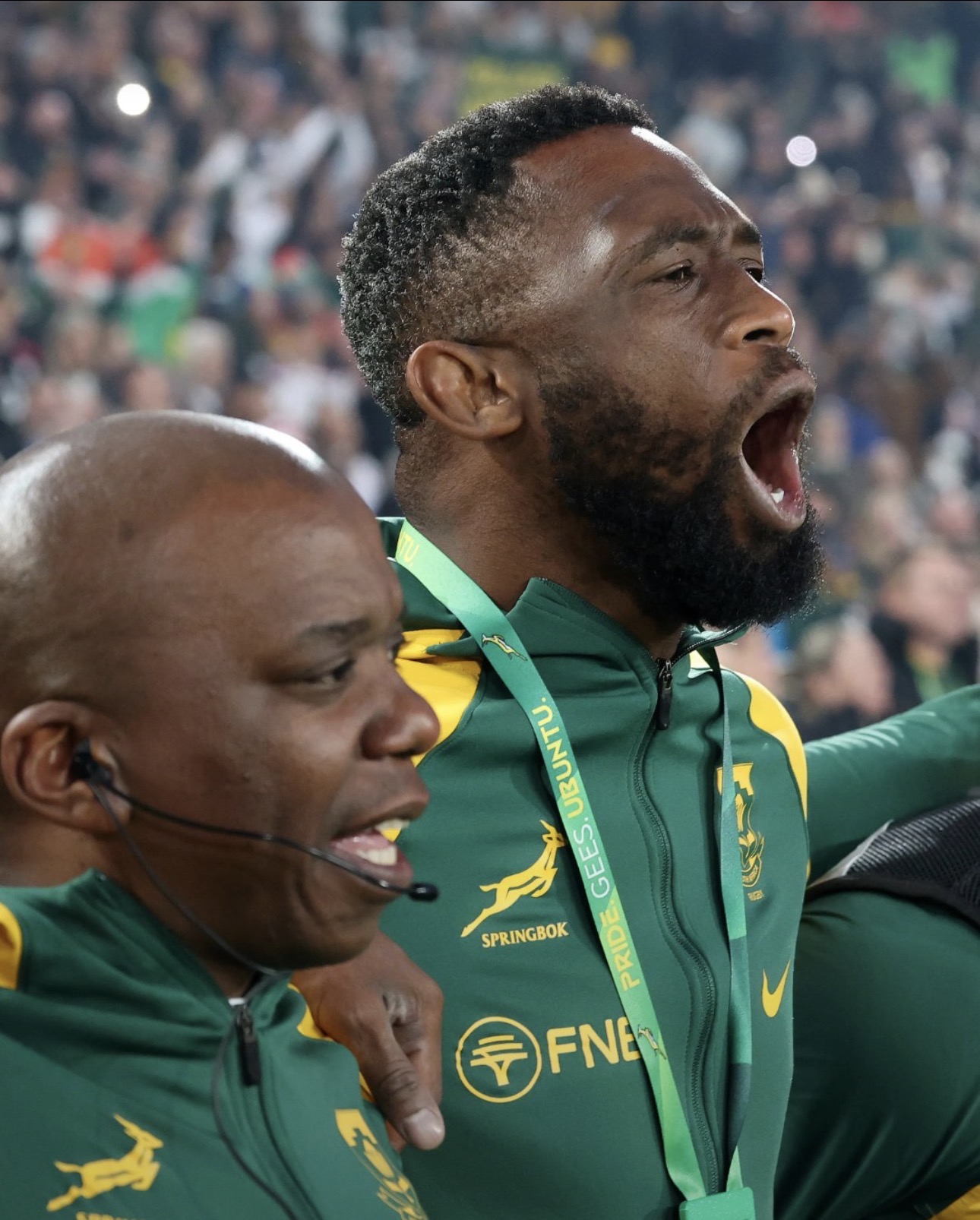 Siya KolisiSouth Africa · File photo · Springbok centurion, the ninth, reaching 100 Tests against France in Paris in November 2025. His fitness for Ellis Park is unresolved.
Of course, the rugby is only half of a Greatest Rivalry week. Rassie has shoved the team announcement to Thursday, days later than his usual Monday or Tuesday, and offered two completely incompatible explanations with a completely straight face: “the less time they have to prepare for our team, the better” to one room, and to the New Zealand press, “not an arrogant thing… out of respect.” Then All Blacks coach Dave Rennie accused the Boks of tactical set-piece dawdling after the Sharks match — and Rassie's response was to bring former Test referee Jaco Peyper to the media briefing as a law adviser, who patiently explained that the thirty-second clock only starts when the referee marks the mark, and that there had been “not one piece of feedback that we slow down the game.” Rassie's own contribution to jurisprudence: “there are always three truths…”, followed by the defence that our lineout calls take a moment because the squad operates in eleven languages. Rennie's comeback was to point at a fifty-second Sharks lineout. Nobody is backing down. Nobody wants to.
Then we opened a second front, because of course we did. Assistant Felix Jones said South African franchises had flagged All Blacks “tucked shoulders… reverse-arm, non-wrapping” cleanouts and leg-lifting at the maul, and added that the “brutality… does follow his coaching.” New Zealand writer Patrick McKendry called that “a step too far” — which is the polite Kiwi way of saying it landed. None of this is new, mind you. It's the current chapter of a very well-documented book: the Bomb Squad, born as a 6-2 split against Italy in 2019 and escalated to the 7-1 used against these very All Blacks at Twickenham and in the final; the hybrid 90kg-plus selections with Esterhuizen packing down at flank; assistant Daan Human cheerfully floating an 8-0 bench; the water-carrier era, ended when World Rugby banned directors of rugby from carrying water on 1 July 2022; Rassie's sixty-two-minute video review of referee Nic Berry in the 2021 Lions series, which cost him a two-month ban from all rugby and roughly ten months away from matchdays, plus another two matches in November 2022; and France's leaked line-up finding its way online in November 2025. Matt Williams calls it “abusing the bench… against the spirit of the game.” Gregor Townsend, Nigel Owens and Keith Wood want tactical substitutions capped. In the other corner, World Rugby chief executive Alan Gilpin and sports scientist Ross Tucker have both examined it and shrugged. The world calls it cheating. We call it Tuesday.
In the interests of full disclosure, this tour has also broken the media. Outlets cannot agree on the first Test date — most say 22 August, one insists on the 17th. They cannot agree how long the Boks' unbeaten run is: some say five, some say twelve, everyone agrees the last defeat was Eden Park on 6 September 2025. A Wits University training base has been doing the rounds and we could not find it in a single August source, so we're calling it a rumour until somebody produces a photograph. And Siya Kolisi's scan result — after he pulled up with that hamstring twenty-five minutes into Buenos Aires — has not appeared anywhere, which means forty million amateur physiotherapists are refreshing their phones into Thursday. Even the statisticians are struggling: territory percentages only exist for four of the nine Tests above, nobody publishes scrum penalties or lineout steals separately, and both SuperSport's and allblacks.com's stat panels are JavaScript-rendered, so the granular tour numbers are locked in a vault. Meanwhile one records site still lists the head-to-head as 106 Tests. Ignore it. It's 110.
We are not going to sit here and promise you it will be easy, because the last time somebody told this country a Test against New Zealand would be easy, it finished 57-0 in Albany. But here is where we stand. Thirty years since they last toured. Four Tests to settle it. One hundred and ten matches of history behind it. The number one ranking on the line in game one. They arrive with 142 points of momentum and four matches in sixteen days in their legs. We arrive as world champions, unbeaten in 2026, ranked first, 9-6 at this ground, holders of the heaviest win in the fixture's history, with a five-penalty discipline record the last time we played here and a coach who brings referees to press conferences. Ellis Park. Saturday. Bring a cushion, a cardiologist and a flag.